
RBSE Class 12th 2013 Accountancy-SS-30-2013 Previous Year Papers
Accountancy-SS-30-2013 from the 2013 exam year is part of the Class 12th previous year papers archive on RBSE Solution. Many learners start here after finishing the textbook to see how questions were actually framed on the Rajasthan Board of Secondary Education (RBSE) paper.
Treat this question paper as a mock under gentle timing first, then as a marking exercise the second time. The introduction on this page is written only for this subject-and-year pair, not copied from other pages.
Bookmark the link if you coach juniors — the layout stays stable for search engines and classroom sharing.
Paper details
Quick reference for this previous year papers page — confirm board, class, and year & subject before you study.
| Board | RBSE |
|---|---|
| Class | Class 12th |
| Exam year | 2013 |
| Subject | Accountancy-SS-30-2013 |
| Resource type | Previous Year Papers |
| Category | RBSE Previous Year Question Papers |
| Website | RBSE Solution |
The table summarises this Previous Year Papers resource. Confirm RBSE, Class 12th, year 2013, and subject Accountancy-SS-30-2013 before studying.
RBSE Solution organises previous year papers so each URL carries chapter-specific guidance — better for students and for search engines than one generic paragraph for the whole class.
Turning 2013 papers into insight
One Accountancy-SS-30-2013 paper reveals style; several from the same year reveal pattern. After this page, open sibling subjects listed below to see whether marks cluster in certain units.
Keep rough work dated in your notebook. Examiners in Class 12th expect clear numbering even in practice sessions.
Stay Connected with RBSE Solutions
Get exam updates, new PDFs, and important notices on the channels students already use.
RBSE Class 12th 2013 Accountancy-SS-30-2013
Scroll through the Previous Year Papers pages for Accountancy-SS-30-2013 (2013).



Rajasthan Board Class 12th Accountancy-SS-30-2013 2013 solved Previous Year Question Papers
उच्च माध्यमिक परीक्षा, 2013
SENIOR SECONDARY EXAMINATION, 2013
लेखाशास्त्र
ACCOUNTANCY
समय : 3 घण्टे पूर्णांक : 80
परीक्षार्थियों के लिए सामान्य निर्देश :
GENERAL INSTRUCTIONS TO THE EXAMINEES :
- परीक्षार्थी सर्वप्रथम अपने प्रश्न पत्र पर नामांक अनिवार्यतः लिखें।
Candidate must write first his / her Roll No. on the question paper compulsorily. - सभी प्रश्न अनिवार्य हैं।
All the questions are compulsory. - प्रत्येक प्रश्न का उत्तर दी गई उत्तर पुस्तिका में ही लिखें।
Write the answer to each question in the given answer-book only. - जिन प्रश्नों में आन्तरिक खण्ड हैं, उन सभी के उत्तर एक साथ ही लिखें।
For questions having more than one part, the answers to those parts are to be written together in continuity. - प्रश्न पत्र के हिन्दी एवं अंग्रेजी रूपान्तरण में किसी प्रकार की त्रुटि / अन्तर / विरोधाभास होने पर हिन्दी भाषा के प्रश्न को ही सही मानें।
If there is any error / difference / contradiction in Hindi & English versions of the question paper, the question of Hindi version should be treated valid. - यह प्रश्न पत्र दो खण्डों में विभक्त है -- अ और ब
- खण्ड ‘अ’ सभी छात्रों के लिए अनिवार्य है।
- खण्ड ‘अ’ के दो भाग हैं, प्रत्येक भाग में सात प्रश्न हैं। परीक्षार्थी को किसी एक भाग के सभी सात प्रश्नों के हल करना है।
SS—30-Accountancy SS-558 [ Turn over ]
Exam Instructions (Page 2 of 15)
i) This question paper contains two Parts A and B.
ii) Part 'A' is compulsory for all candidates.
iii) Part 'B' has two portions. Every portion has 'a set' of seven questions. Candidate can attempt only a set of seven questions of any one portion.
7. Marks Distribution
| Part | Question Nos. | Marks per question |
|---|---|---|
| A | 1-8 | 1 |
| 9-14 | 2 | |
| 15-21 | 4 | |
| 22-23 | 6 | |
| B | 24-25 | 1 |
| 26-27 | 2 | |
| 28-29 | 4 | |
| 30 | 6 |
OR
| 24-25 | 1 |
| 26-27 | 2 |
| 28-29 | 4 |
| 30 | 6 |
8. Internal Choices
प्रश्न संख्या 22 (भाग-अ) तथा 30 (भाग-ब) में आन्तरिक विकल्प हैं।
There are internal choices in Q. No. 22 (Part-A) and Q. No. 30 (Part-B).
SS—30-Accountancy SS-558
खण्ड - अ / PART - A
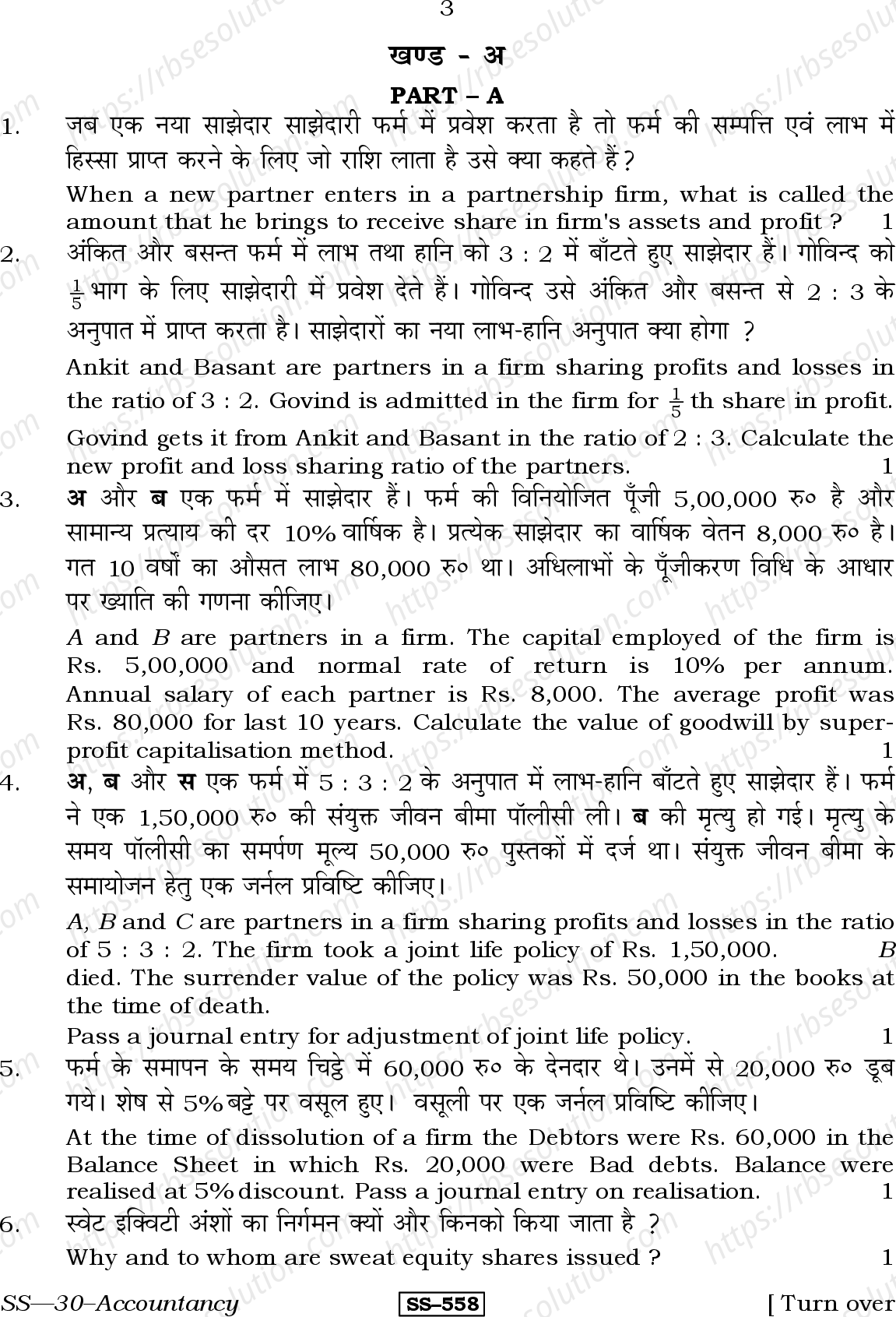
प्रश्न 1. जब एक नया साझेदार साझेदारी फर्म में प्रवेश करता है तो फर्म की सम्पत्ति एवं लाभ में हिस्सा प्राप्त करने के लिए जो राशि लाता है उसे क्या कहते हैं ?
When a new partner enters in a partnership firm, what is called the amount that he brings to receive share in firm's assets and profit?
उत्तर: इसे ख्याति (Goodwill) कहते हैं। नया साझेदार फर्म में प्रवेश करते समय भविष्य के लाभों में हिस्सा पाने के लिए ख्याति की राशि लाता है।
Answer: It is called Goodwill. The new partner brings this amount to acquire a share in future profits of the firm.
प्रश्न 2. अंकित और बसन्त फर्म में लाभ तथा हानि को 3 : 2 में बाँटते हुए साझेदार हैं। गोविन्द को 1/4 भाग के लिए साझेदारी में प्रवेश देते हैं। गोविन्द उसे अंकित और बसन्त से 2 : 3 के अनुपात में प्राप्त करता है। साझेदारों का नया लाभ-हानि अनुपात क्या होगा ?
Ankit and Basant are partners in a firm sharing profits and losses in the ratio of 3 : 2. Govind is admitted in the firm for 1/4th share in profit. Govind gets it from Ankit and Basant in the ratio of 2 : 3. Calculate the new profit and loss sharing ratio of the partners.
हल:
गोविन्द का हिस्सा = 1/4
गोविन्द अंकित से लेता है = (1/4) × (2/5) = 2/20 = 1/10
गोविन्द बसन्त से लेता है = (1/4) × (3/5) = 3/20
अंकित का नया हिस्सा = 3/5 - 1/10 = (6 - 1)/10 = 5/10 = 1/2
बसन्त का नया हिस्सा = 2/5 - 3/20 = (8 - 3)/20 = 5/20 = 1/4
गोविन्द का हिस्सा = 1/4
नया अनुपात = 1/2 : 1/4 : 1/4 = 2 : 1 : 1
उत्तर: नया लाभ-हानि अनुपात 2 : 1 : 1 होगा।
Answer: New profit sharing ratio is 2 : 1 : 1.
प्रश्न 3. अ और ब एक फर्म में साझेदार हैं। फर्म की विनियोजित पूँजी 5,00,000 रु. है और सामान्य प्रत्याय की दर 10% वार्षिक है। प्रत्येक साझेदार का वार्षिक वेतन 8,000 रु. है। गत 10 वर्षों का औसत लाभ 80,000 रु. था। अधिलाभों के पूँजीकरण विधि के आधार पर ख्याति की गणना कीजिए।
A and B are partners in a firm. The capital employed of the firm is Rs. 5,00,000 and normal rate of return is 10% per annum. Annual salary of each partner is Rs. 8,000. The average profit was Rs. 80,000 for last 10 years. Calculate the value of goodwill by super-profit capitalisation method.
हल:
औसत लाभ = 80,000 रु.
साझेदारों का कुल वार्षिक वेतन = 8,000 × 2 = 16,000 रु.
समायोजित औसत लाभ = 80,000 - 16,000 = 64,000 रु.
सामान्य लाभ = विनियोजित पूँजी × सामान्य प्रत्याय दर = 5,00,000 × 10/100 = 50,000 रु.
अधिलाभ = समायोजित औसत लाभ - सामान्य लाभ = 64,000 - 50,000 = 14,000 रु.
ख्याति = (अधिलाभ × 100) / सामान्य प्रत्याय दर = (14,000 × 100) / 10 = 1,40,000 रु.
उत्तर: ख्याति का मूल्य 1,40,000 रु. है।
Answer: Value of goodwill is Rs. 1,40,000.
प्रश्न 4. अ, ब और स एक फर्म में 5 : 3 : 2 के अनुपात में लाभ-हानि बाँटते हुए साझेदार हैं। फर्म ने एक 1,50,000 रु. की संयुक्त जीवन बीमा पॉलीसी ली। ब की मृत्यु हो गई। मृत्यु के समय पॉलीसी का समर्पण मूल्य 50,000 रु. पुस्तकों में दर्ज था। संयुक्त जीवन बीमा के समायोजन हेतु एक जर्नल प्रविष्टि कीजिए।
A, B and C are partners in a firm sharing profits and losses in the ratio of 5 : 3 : 2. The firm took a joint life policy of Rs. 1,50,000. B died. The surrender value of the policy was Rs. 50,000 in the books at the time of death. Pass a journal entry for adjustment of joint life policy.
हल:
बीमा पॉलीसी का समर्पण मूल्य 50,000 रु. है, जो पुस्तकों में दर्ज है। मृत्यु के समय, इस राशि को साझेदारों के पूँजी खातों में उनके लाभ-हानि अनुपात (5:3:2) में हस्तांतरित किया जाता है।
जर्नल प्रविष्टि:
| विवरण | नाम (Dr.) | जमा (Cr.) |
|---|---|---|
| संयुक्त जीवन बीमा पॉलीसी खाता...नाम | 50,000 | |
| अ के पूँजी खाते से (50,000 × 5/10) | 25,000 | |
| ब के पूँजी खाते से (50,000 × 3/10) | 15,000 | |
| स के पूँजी खाते से (50,000 × 2/10) | 10,000 | |
| (संयुक्त जीवन बीमा पॉलीसी के समर्पण मूल्य का साझेदारों के पूँजी खातों में हस्तांतरण) |
व्याख्या: बीमा पॉलीसी का समर्पण मूल्य फर्म की सम्पत्ति है, जिसे मृत्यु के समय साझेदारों के पूँजी खातों में उनके पुराने अनुपात में बाँटा जाता है।
Explanation: The surrender value of the joint life policy is an asset of the firm, which is transferred to partners' capital accounts in their old profit-sharing ratio at the time of death.
प्रश्न 5. फर्म के समापन के समय चिट्ठे में 60,000 रु. के देनदार थे। उनमें से 20,000 रु. डूब गये। शेष से 5% बट्टे पर वसूल हुए। वसूली पर एक जर्नल प्रविष्टि कीजिए।
At the time of dissolution of a firm the Debtors were Rs. 60,000 in the Balance Sheet in which Rs. 20,000 were Bad debts. Balance were realised at 5% discount. Pass a journal entry on realisation.
हल:
कुल देनदार = 60,000 रु.
डूबत ऋण = 20,000 रु.
शेष देनदार = 60,000 - 20,000 = 40,000 रु.
5% बट्टा = 40,000 × 5/100 = 2,000 रु.
वसूली राशि = 40,000 - 2,000 = 38,000 रु.
जर्नल प्रविष्टि:
| विवरण | नाम (Dr.) | जमा (Cr.) |
|---|---|---|
| रोकड़ खाता...नाम | 38,000 | |
| वसूली खाता...नाम (हानि) | 22,000 | |
| देनदार खाते से | 60,000 | |
| (देनदारों से वसूली एवं हानि का लेखा) |
व्याख्या: 20,000 रु. डूबत ऋण और 2,000 रु. बट्टा मिलाकर कुल 22,000 रु. की हानि वसूली खाते में डेबिट की गई।
Explanation: Total loss of Rs.
उत्तर / Answer: संचित पूँजी (Reserved Capital) कम्पनी द्वारा तब माँगी जाती है जब कम्पनी समापन (liquidation) की स्थिति में हो। सामान्यतः इसे तब तक नहीं माँगा जाता जब तक कम्पनी चालू रहती है। एक उद्देश्य / One purpose: इसका उद्देश्य कम्पनी के समापन के समय लेनदारों को भुगतान करने के लिए अतिरिक्त कोष उपलब्ध कराना है, जिससे लेनदारों के हितों की रक्षा हो सके। उत्तर / Answer: जब ऋणपत्र समपाश्चिक प्रतिभूति (collateral security) के रूप में निर्गमित किए जाते हैं, तो कोई प्रविष्टि ऋणपत्र खाते में नहीं की जाती। केवल एक स्मरण पंजी (memorandum entry) की जाती है: प्रविष्टि / Entry: समपाश्चिक प्रतिभूति के रूप में निर्गमित ऋणपत्र खाता ... डेबिट (यह प्रविष्टि केवल लेखा पुस्तकों में रिकॉर्ड के लिए होती है, वास्तविक ऋण निर्माण नहीं होता।) उत्तर / Answer: हल / Solution: चरण 1: नयी फर्म की कुल पूँजी ज्ञात करें। चरण 2: पुराने साझेदारों की वास्तविक पूँजी ज्ञात करें। चरण 3: ख्याति की गणना करें। निष्कर्ष: फर्म की ख्याति का मूल्य 0 रु० है। (C द्वारा लाई गई पूँजी उसके हिस्से के अनुपात में पूरी फर्म की पूँजी के बराबर है, इसलिए कोई ख्याति नहीं है।) हल / Solution: चरण 1: गोविन्द के अवकाश ग्रहण के समय उसकी पूँजी का शेष = 20,000 रु० चरण 2: 6 माह के लाभ में गोविन्द का हिस्सा ज्ञात करें। चरण 3: 6 माह बाद गोविन्द को देय कुल राशि = अवकाश के समय की पूँजी + लाभ में हिस्सा उत्तर: 6 माह बाद गोविन्द को 21,600 रु० का भुगतान प्राप्त होगा। उत्तर / Answer: हल / Solution: प्रविष्टियाँ / Journal Entries: नोट: चूँकि 4,000 अंश × 100 रु० = 4,00,000 रु०, जबकि मशीनरी का मूल्य 5,00,000 रु० है, अतः 1,00,000 रु० का अंतर प्रतिभूति प्रीमियम (Securities Premium) के रूप में दर्शाया गया है। एक कम्पनी ने 1 अप्रैल, 20ll को 10% वाले 2,000 ऋणपत्रों को 100 रु. प्रत्येक पर 10% बट्टे पर निर्गमित किया जिनका शोधन सम मूल्य पर 4 वर्ष पश्चात किया जाना है। निर्गमन एवं बट्टे को अपलिखित करने की केवल प्रथम वर्ष की जर्नल प्रविष्टियाँ कीजिए। On 1st April, 20ll a company issued 10%, 2000 debentures of Rs. 100 each at 10% discount which will be redeemable at par after four years. Write journal entries for issue and discount written off only for first year. Solution: Total face value = 2,000 × 100 = Rs. 2,00,000 Journal Entries: पवन एक फर्म में साझेदार है। उसने 31 मार्च, 202 को समाप्त वर्ष में निम्न राशियाँ आहरित की : आहरण पर 2% वार्षिक ब्याज लगाया जाता है। आहरण पर ब्याज की गणना कीजिए। Pawan is a partner in a firm. He withdrew the following amounts during the year ended on 31st March, 202: Interest on drawing is to be charged @2% p.a. Calculate Interest on drawings. Solution: Interest on drawings is calculated for the period from the date of withdrawal to the end of the accounting year (31st March, 202). Interest on Drawings = (Total Product × Rate) / (12 × 100) Interest on Drawings = Rs. 891.67 स्थिर और परिवर्तनशील पूँजी खातों में कोई चार अन्तर लिखिए। Write any four differences between fixed and fluctuating capital accounts. मोहन, मनोज और मणीष एक फर्म में साझेदार हैं जो लाभ-हानि को 3:2:1 के अनुपात में विभाजित करते हैं। साझेदारी संलेख में यह व्यवस्था है कि किसी साझेदार के अवकाश ग्रहण करने पर उसे दी जाने वाली राशि का भुगतान वार्षिकी द्वारा किया जायेगा। 31 मार्च, 2008 को मोहन फर्म से अवकाश ग्रहण करता है। उसके हिस्से की राशि का निर्धारण 50,000 रु. किया गया। संलेख के अनुसार, अवकाश ग्रहण करने वाले साझेदार की देय राशि का भुगतान 10,000 रु. की वार्षिकी के रूप में प्रत्येक वर्ष किया जायेगा। Mohan, Manoj and Manish are partners in a firm sharing profits and losses in the ratio of 3:2:1. The partnership deed provides that on retirement of a partner, the amount payable to him shall be paid by annuity. On 31st March, 2008, Mohan retires from the firm. His share amount is determined as Rs. 50,000. According to the deed, the amount payable to the retiring partner shall be paid as an annuity of Rs. 10,000 each year. Solution: Mohan's share = Rs. 50,000 The journal entry for recording the annuity payment arrangement: Each year, when annuity is paid: मोहन, मनोज और मनीष एक फर्म में साझेदार हैं, जो लाभ-हानि को 3:2:1 के अनुपात में बाँटते हैं। साझेदारी संलेख के अनुसार, किसी साझेदार की सेवानिवृत्ति पर उसे देय राशि वार्षिकी द्वारा निपटाई जाएगी। 31 मार्च, 2008 को मोहन सेवानिवृत्त होता है। उसके हिस्से की राशि 50,000 रुपये निर्धारित की गई। यह राशि संलेख के अनुसार 10,000 रुपये की वार्षिकी में परिवर्तित कर दी गई, जो प्रत्येक वर्ष 1 अप्रैल को देय थी। 4 अप्रैल, 2008 को मोहन की मृत्यु हो गई। यह मानते हुए कि अदत्त शेष पर 10% वार्षिक की दर से ब्याज दिया जाता है, वार्षिकी उचन्ती खाता बनाइए। वार्षिकी उचन्ती खाता (Annuity Suspense Account) * ब्याज की गणना: 40,000 × 10% × (4/365) = 43.84 रु, लगभग 44 रु। व्याख्या: मोहन की मृत्यु के बाद, शेष वार्षिकी राशि (40,000 रु) और उस पर ब्याज उसके लाभार्थी को देय होता है। मैसर्स राम एण्ड ब्रदर्स को 31 मार्च, 2014 को विघटित कर दिया गया। उस तिथि पर सम्पत्तियाँ एवं दायित्व निम्न प्रकार थे: अन्य सूचनाएँ: वसूली खाता (Realisation Account) व्याख्या: वसूली खाते में सभी सम्पत्तियों (नकद को छोड़कर) और दायित्वों को स्थानांतरित किया जाता है। देनदारों से 17,000 रु वसूले गए (8,000 रु डूबत ऋण के बाद)। विविध सम्पत्तियों में से 10,000 रु की सम्पत्ति राम ने ली और शेष 8,000 रु में बेची गई। वसूली पर कुल लाभ 10,000 रु (सामान्य संचय सहित) साझेदारों के लाभ अनुपात में बाँटा गया। Realisation Account Working Notes: Journal Entries in the books of Om Ltd. Note: The reissue price is assumed at ₹40 per share (fully paid up) as per the problem. If reissue was at a discount, the discount amount would be debited to Share Forfeiture A/c. Journal Entries in the books of X Ltd.7. 'संचित पूँजी' कम्पनी द्वारा कब माँगी जाती है? इसका एक उद्देश्य बताइए।
When is 'Reserved Capital' called by the company? Write any one purpose of it.8. समपाश्चिक प्रतिभूति के रूप में निर्गमित किये गये ऋणपत्रों के सम्बन्ध में क्या प्रविष्टि होगी?
What will be the entry when the debentures are issued as collateral security?
ऋणपत्र समपाश्चिक प्रतिभूति खाता ... क्रेडिट9. साझेदारी विलेख के अभाव में लागू होने वाले चार नियम लिखिए।
Write any four rules applicable in the absence of partnership deed.
10. अ और ब क्रमशः 20,000 रु० और 10,000 रु० की पूँजी के साथ साझेदार हैं। उन्होंने फर्म के लाभों में 1/4 हिस्से के साथ स को साझेदार के रूप में प्रवेश दिया। स अपने हिस्से की पूँजी के रूप में 10,000 रु० लाता है। फर्म की ख्याति के मूल्य की गणना कीजिए।
A and B are partners with capital of Rs. 20,000 and Rs. 10,000. They admitted C as a partner with 1/4th share of firm's profit. C brings Rs. 10,000 as his share of capital. Calculate the value of firm's goodwill.
C का हिस्सा = 1/4, C द्वारा लाई गई पूँजी = 10,000 रु०
यदि 1/4 हिस्से की पूँजी 10,000 रु० है, तो पूरी फर्म की पूँजी = 10,000 × 4 = 40,000 रु०
A की पूँजी = 20,000 रु०
B की पूँजी = 10,000 रु०
कुल पुरानी पूँजी = 20,000 + 10,000 = 30,000 रु०
ख्याति = नयी फर्म की कुल पूँजी - पुरानी पूँजी - C द्वारा लाई गई पूँजी
ख्याति = 40,000 - 30,000 - 10,000 = 0 रु०11. अनिल, सुनील और गोविन्द 2 : 2 : 1 के अनुपात में लाभ एवं हानि बाँटने वाले साझेदार हैं। गोविन्द के अवकाश ग्रहण करने पर सभी समायोजनों के बाद साझेदारों के पूँजी खातों के शेष क्रमशः 40,000 रु०, 30,000 रु० व 20,000 रु० थे। अनिल और सुनील ने गोविन्द को भुगतान का निस्तारण किये बिना अगले 6 माह तक व्यापार चालू रखने का निश्चय किया। इस 6 माह की अवधि में फर्म ने 8,000 रु० का लाभ अर्जित किया। 6 माह बाद गोविन्द को कितनी राशि का भुगतान प्राप्त होगा?
Anil, Sunil and Govind are partners sharing profits and losses in the ratio of 2:2:1. At Govind's retirement the balance of the partners capital A/c after making all adjustments were Rs. 40,000, Rs. 30,000 and Rs. 20,000 respectively. Anil and Sunil decided to continue business for next 6 months without disposal of Govind's payment. Rs. 8,000 profit was earned by the firm during these six months. After six months what will be the amount received by Govind?
लाभ = 8,000 रु०
गोविन्द का लाभ में हिस्सा = 1/5 (क्योंकि अनुपात 2:2:1 है)
गोविन्द का हिस्सा = 8,000 × 1/5 = 1,600 रु०
= 20,000 + 1,600 = 21,600 रु०12. फर्म का न्यायालय द्वारा समापन की चार परिस्थितियों के नाम लिखिए।
Write any four conditions when the firm is dissolved by the court.
13. एक्स लिमिटेड ने पी लिमिटेड से 5,00,000 रु० की एक मशीन खरीदी। एक्स लिमिटेड ने 100 रु० वाले 4,000 अंश पूर्ण भुगतान में निर्गमित किये। एक्स लिमिटेड की पुस्तकों में जर्नल प्रविष्टियाँ दीजिए।
X Ltd. purchased a machinery from P Ltd. for Rs. 5,00,000. X Ltd. issued 4,000 shares of Rs. 100 each in full settlement. Give journal entries in the books of X Ltd.
दिनांक
विवरण
डेबिट (रु०)
क्रेडिट (रु०)
मशीनरी खाता ...डेबिट
5,00,000
पी लिमिटेड खाता ...क्रेडिट
5,00,000
(मशीनरी खरीदी)
पी लिमिटेड खाता ...डेबिट
5,00,000
समता अंश पूँजी खाता ...क्रेडिट
4,00,000
प्रतिभूति प्रीमियम खाता ...क्रेडिट
1,00,000
(4,000 अंश 100 रु० प्रति अंश की दर से निर्गमित, जिनका अंकित मूल्य 100 रु० है, कुल 4,00,000 रु०; शेष 1,00,000 रु० प्रीमियम के रूप में)
4.
Discount = 10% of 2,00,000 = Rs. 20,000
Issue price = 2,00,000 - 20,000 = Rs. 1,80,000
Date
Particulars
L.F.
Dr. (Rs.)
Cr. (Rs.)
1st Apr, 20ll
Bank A/c Dr.
Discount on Issue of Debentures A/c Dr.
To 10% Debentures A/c
(Being issue of 2,000 debentures at 10% discount)
1,80,000
20,000
2,00,000
31st Mar, 20ll
Statement of Profit & Loss A/c Dr.
To Discount on Issue of Debentures A/c
(Being discount written off for first year: 20,000/4 = 5,000)
5,000
5,000
15.
Date
Amount (Rs.)
Period (months)
Product (Rs. × months)
1st July, 20ll
20,000
9
1,80,000
31st Aug, 20ll
40,000
7
2,80,000
1st Oct, 20ll
10,000
6
60,000
31st Jan, 202
5,000
2
10,000
1st Mar, 202
5,000
1
5,000
31st Mar, 202
10,000
0
0
Total
90,000
5,35,000
= (5,35,000 × 2) / (12 × 100)
= 10,70,000 / 1,200
= Rs. 891.6716.
Basis
Fixed Capital Account
Fluctuating Capital Account
1. Number of Accounts
Two accounts are maintained: Capital A/c and Current A/c
Only one account is maintained: Capital A/c
2. Capital Balance
Capital account balance remains fixed (unchanged) except for additional capital introduced or permanent withdrawal
Capital account balance fluctuates with each transaction (drawings, interest, salary, etc.)
3. Recording of Transactions
All adjustments (drawings, interest, salary, share of profit/loss) are recorded in Current Account
All adjustments are recorded directly in Capital Account
4. Suitability
Suitable when partners want to maintain a fixed capital base
Suitable when partners frequently change their capital contributions
17.
Annual annuity payment = Rs. 10,000
Number of years = 50,000 / 10,000 = 5 years
Date
Particulars
L.F.
Dr. (Rs.)
Cr. (Rs.)
31st Mar, 2008
Mohan's Capital A/c Dr.
To Mohan's Loan A/c
(Being amount due to Mohan transferred to loan account to be paid by annuity of Rs. 10,000 per year)
50,000
50,000
Date
Particulars
L.F.
Dr. (Rs.)
Cr. (Rs.)
(Each year)
Mohan's Loan A/c Dr.
To Bank A/c
(Being annuity payment of Rs. 10,000 made to Mohan)
10,000
10,000
प्रश्न 1 (भाग 1): वार्षिकी उचन्ती खाता (Annuity Suspense Account)
दिनांक
विवरण
राशि (रु)
दिनांक
विवरण
राशि (रु)
31 मार्च 2008
मोहन का पूँजी खाता
50,000
1 अप्रैल 2008
बैंक खाता (वार्षिकी भुगतान)
10,000
4 अप्रैल 2008
मोहन के लाभार्थी को देय (शेष राशि)
40,000
4 अप्रैल 2008
ब्याज (40,000 × 10% × 4/365)
44*
योग
50,000
योग
50,044
प्रश्न 2 (भाग 2): वसूली खाता (Realisation Account)
चिट्ठा (Balance Sheet) 31 मार्च, 2014 को
दायित्व
राशि (रु)
सम्पत्तियाँ
राशि (रु)
लेनदार
20,000
नकद
10,000
सामान्य संचय
10,000
देनदार
30,000
पूँजी खाते:
घटाया: डूबत ऋण आयोजन
(5,000)
राम
30,000
शुद्ध देनदार
25,000
मोहन
20,000
विविध सम्पत्तियाँ
30,000
सोहन की पूँजी
5,000
योग
85,000
योग
85,000
विवरण
राशि (रु)
विवरण
राशि (रु)
देनदार
25,000
लेनदार (भुगतान)
20,000
विविध सम्पत्तियाँ
30,000
देनदारों से वसूली (25,000 - 8,000)
17,000
नकद (प्रारंभिक)
10,000
राम द्वारा ली गई सम्पत्तियाँ
10,000
वसूली पर लाभ (साझेदारों को हस्तांतरित):
शेष सम्पत्तियों की नकद बिक्री
8,000
राम (5/10)
5,000
सामान्य संचय (हस्तांतरित)
10,000
मोहन (3/10)
3,000
सोहन (2/10)
2,000
योग
75,000
योग
75,000
20.
Particulars
Amount (₹)
Particulars
Amount (₹)
To Sundry Assets (transferred)
80,000
By Sohan's Capital A/c (Bad debts)
5,000
To Bank A/c (Realisation expenses, if any)
—
By Bank A/c (Sale of assets)
8,000
To Partners' Capital A/c (Loss transferred)
—
By Ram's Capital A/c (Assets taken over)
—
By Partners' Capital A/c (Profit transferred)
—
Total
80,000
Total
80,000
Om Ltd. – Share Forfeiture and Reissue
Date
Particulars
L.F.
Dr. (₹)
Cr. (₹)
Equity Share Capital A/c (1,000 shares × ₹40) Dr.
40,000
To Share Forfeiture A/c (Amount already paid: Application ₹5 + Allotment ₹5 = ₹10 per share × 1,000)
10,000
To First and Final Call A/c (1,000 shares × ₹32 unpaid)
30,000
(Being forfeiture of 1,000 shares of Mukesh for non-payment of First and Final Call)
Bank A/c (600 shares × ₹40) Dr.
24,000
Share Forfeiture A/c (Discount allowed, if any) Dr.
—
To Equity Share Capital A/c (600 shares × ₹40)
24,000
(Being reissue of 600 forfeited shares to Madan at ₹40 per share fully paid up)
Share Forfeiture A/c (Profit on forfeiture transferred) Dr.
6,000
To Capital Reserve A/c
6,000
(Being profit on forfeiture transferred to Capital Reserve: ₹10,000 forfeited amount – ₹4,000 discount on reissue = ₹6,000)
X Ltd. – Journal Entries for Debenture Redemption
Date
Particulars
L.F.
Dr. (₹)
Cr. (₹)
(i) Redemption by conversion into equity shares
10% Debentures A/c (400 × ₹100) Dr.
40,000
Discount on Issue of Debentures A/c (if any) Dr.
—
To Equity Share Capital A/c (Number of shares × Face value)
40,000
(Being redemption of 400, 10% debentures by issuing equity shares of ₹10 each at par)
(ii) Purchase and cancellation of own debentures
Own Debentures A/c (500 × ₹95) Dr.
47,500