
RBSE Class 12th 2026 MATHEMATICS-SS-15 Previous Year Papers
You opened the RBSE Class 12th 2026 MATHEMATICS-SS-15 Previous Year Papers page — a focused place to read the real previous year question paper for that subject and year. RBSE Solution keeps exam-year sets together so you can practise the same cycle your seniors faced.
Previous year papers reward patience: read instructions, note mark distribution, then attempt questions before peeking at solutions elsewhere on the site. This URL always loads the same free previous year papers content for MATHEMATICS-SS-15 (2026).
Use the details table to confirm class and year, then scroll to the paper images or PDF below. More subjects from 2026 are linked later on this page.
Paper details
Quick reference for this previous year papers page — confirm board, class, and year & subject before you study.
| Board | RBSE |
|---|---|
| Class | Class 12th |
| Exam year | 2026 |
| Subject | MATHEMATICS-SS-15 |
| Resource type | Previous Year Papers |
| Category | RBSE Previous Year Question Papers |
| Website | RBSE Solution |
The table summarises this Previous Year Papers resource. Confirm RBSE, Class 12th, year 2026, and subject MATHEMATICS-SS-15 before studying.
RBSE Solution organises previous year papers so each URL carries chapter-specific guidance — better for students and for search engines than one generic paragraph for the whole class.
How to practise with this question paper
Stage one: read the MATHEMATICS-SS-15 question paper from 2026 without a timer and highlight command words — explain, prove, calculate, discuss. Stage two: attempt selected questions closed-book. Stage three: compare with solutions or teacher feedback.
Previous Year Papers work best when you log mistakes by topic, not only by question number. That log becomes your revision index before pre-boards.
RBSE Class 12th 2026 MATHEMATICS-SS-15
Scroll through the Previous Year Papers pages for MATHEMATICS-SS-15 (2026).

Rajasthan Board Class 12th MATHEMATICS-SS-15 2026 solved Previous Year Question Papers
उच्च माध्यमिक परीक्षा, 2026
SENIOR SECONDARY EXAMINATION, 2026
गणित
MATHEMATICS
समय : 3 घंटे 45 मिनट
पूर्णांक : 80
परीक्षार्थियों के लिए सामान्य निर्देश :
GENERAL INSTRUCTIONS TO THE EXAMINEES:
- परीक्षार्थी सर्वप्रथम अपने प्रश्न-पत्र पर नामांक अनिवार्यत: लिखें।
Candidate must write first his/her Roll No. on the question paper compulsorily. - सभी प्रश्न करने अनिवार्य हैं।
All the questions are compulsory. - प्रत्येक प्रश्न का उत्तर दी गई उत्तर-पुस्तिका में ही लिखें।
Write the answer to each question in the given answer-book only.
No. of Questions: 20
5-Mathematics
No. of Printed Pages: 75
4)
Content not available.
5)
Content not available.
6)
Content not available.
7)
Content not available.
8)
Content not available.
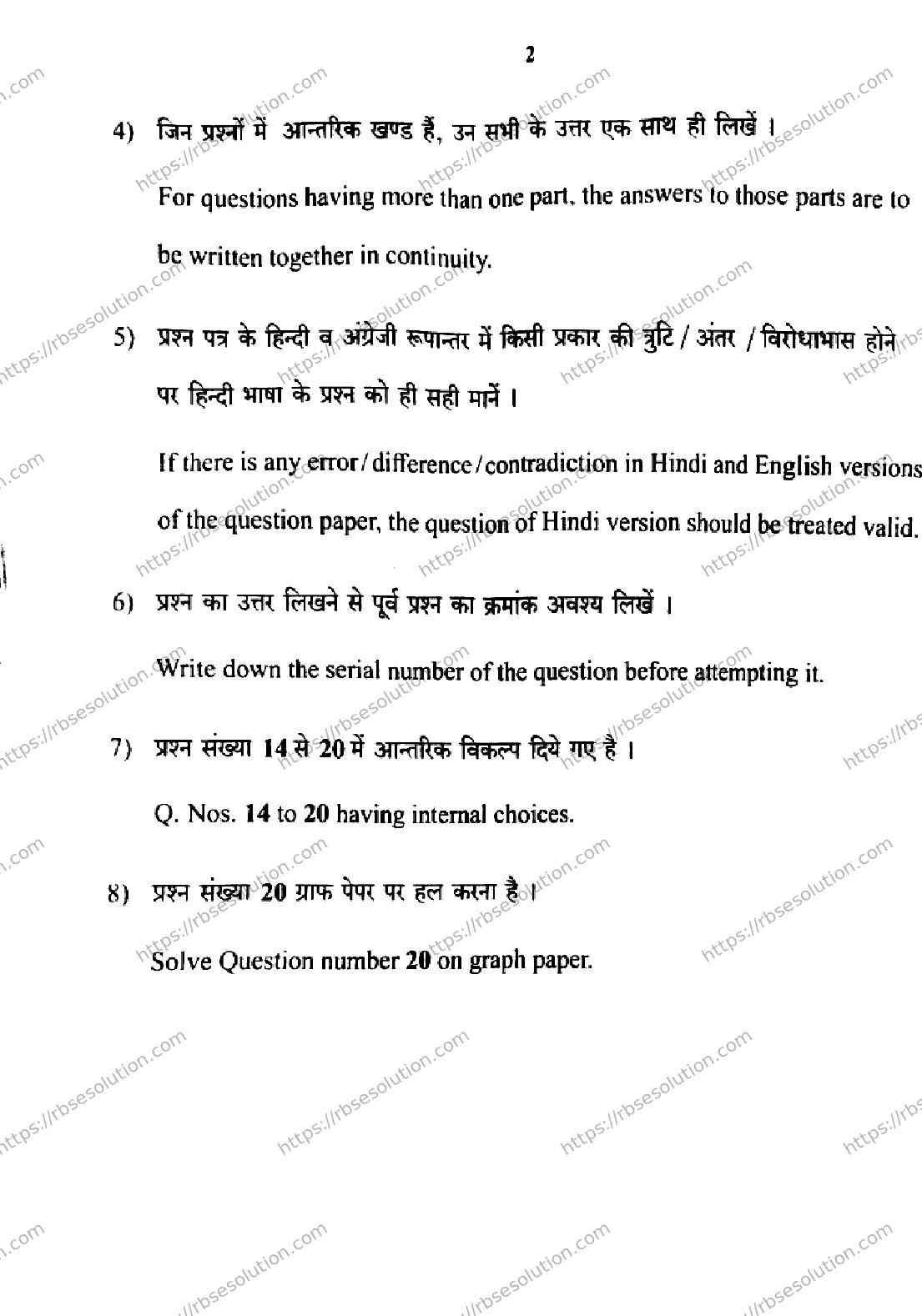
जिन प्रश्नों में आन्तरिक खण्ड हैं, उन सभी के उत्तर एक साथ ही लिखें।
For questions having more than one part, the answers to those parts are to be written together in continuity.
प्रश्न पत्र के हिन्दी एवं अंग्रेजी रूपान्तर में किसी प्रकार की त्रुटि / अंतर / विरोधाभास होने पर हिन्दी भाषा के प्रश्न को ही सही मानें ।
If there is any error / difference / contradiction in Hindi and English versions of the question paper, the question of Hindi version should be treated valid.
प्रश्न का उत्तर लिखने से पूर्व प्रश्न का क्रमांक अवश्य लिखें |
Write down the serial number of the question before attempting it.
प्रश्न संख्या 4 से 20 तक आन्तरिक विकल्प दिये गए है ।
Q. Nos. 4 to 20 having internal choices.
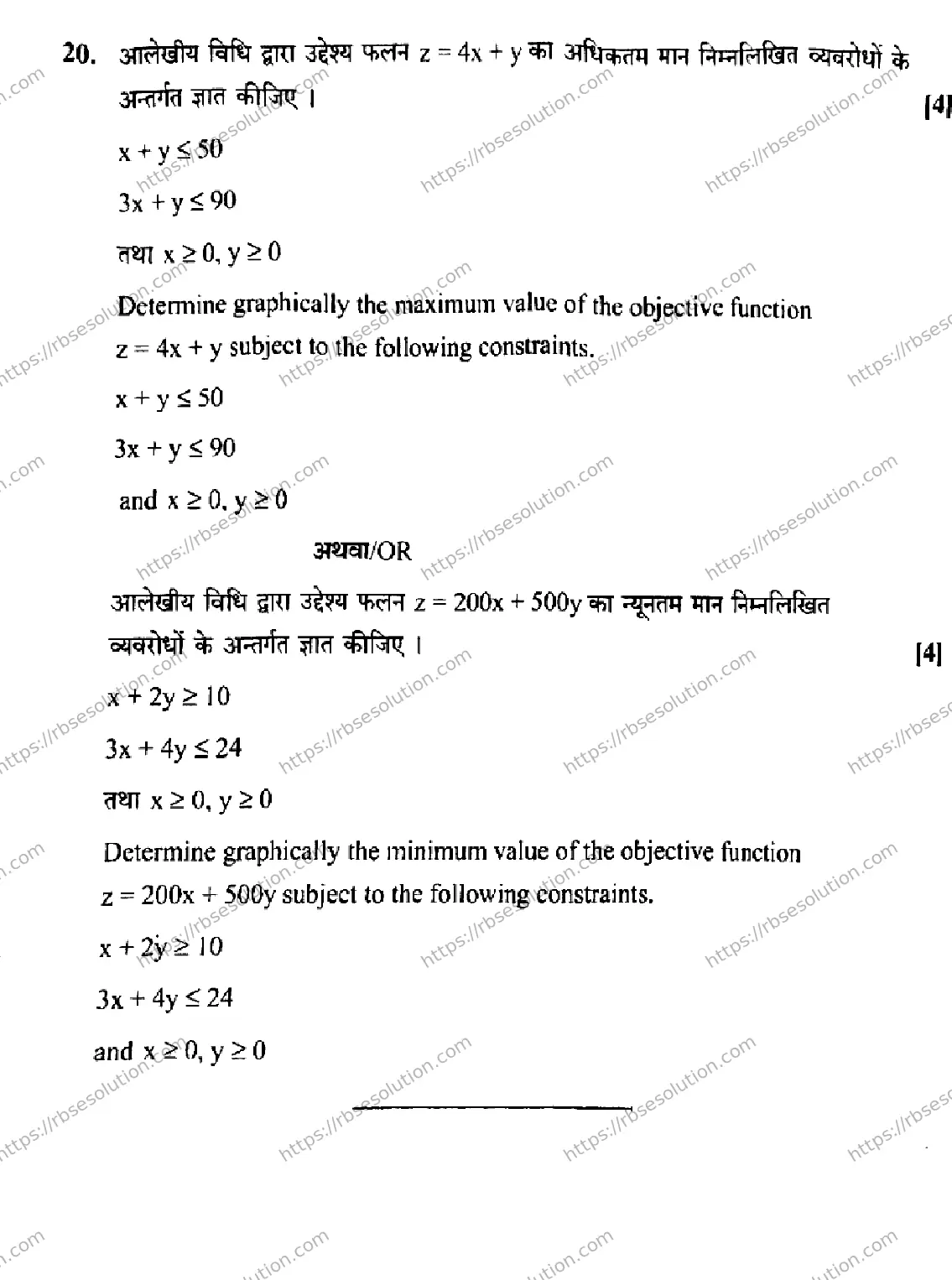
प्रश्न संख्या 20 ग्राफ पेपर पर हल करना |
Solve Question number 20 on graph paper.
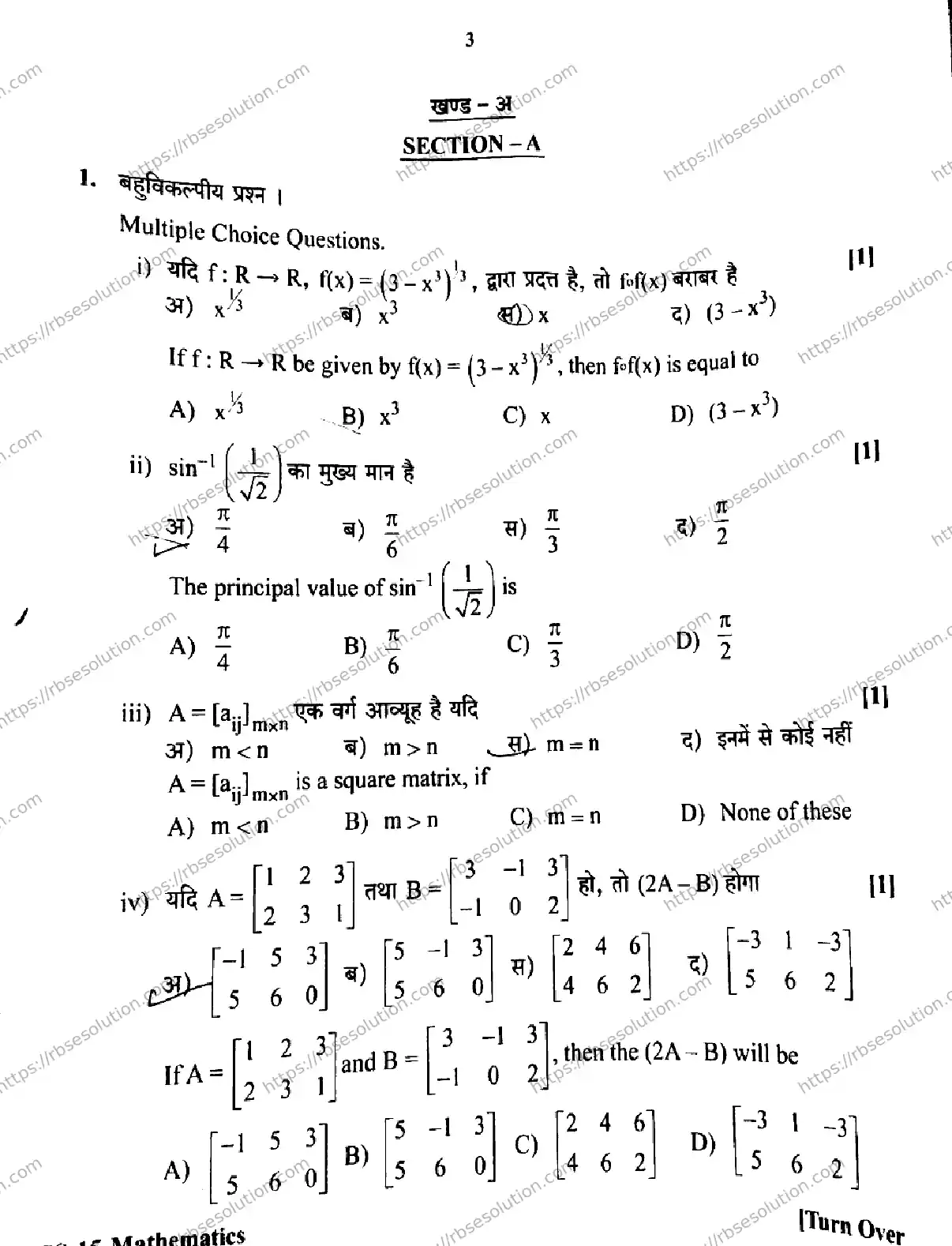
खण्ड-अ / SECTION—A
बहुविकल्पीय प्रश्न / Multiple Choice Questions
-
यदि f : R → R, f(x) = (3 – x³)^(1/3) द्वारा प्रदत्त है, तो f o f(x) बराबर है:
If f : R → R be given by f(x) = (3 – x³)^(1/3), then f o f(x) is equal to:
- A) x³
- B) x
- C) (3 – x³)
- D) (3 – x³)^(1/3)
Correct Answer: B) x
Explanation: f o f(x) = f(f(x)) = f((3 – x³)^(1/3)) = (3 – ((3 – x³)^(1/3))³)^(1/3) = (3 – (3 – x³))^(1/3) = (x³)^(1/3) = x.
-
sin⁻¹(–1/√2) का मुख्य मान है:
The principal value of sin⁻¹(–1/√2) is:
- A) π/4
- B) –π/4
- C) π/3
- D) π/2
Correct Answer: B) –π/4
Explanation: The principal value range for sin⁻¹ is [–π/2, π/2]. Since sin(–π/4) = –1/√2, the principal value is –π/4.
-
यदि A = (aij)m×n एक वर्ग आव्यूह है, यदि:
If A = (aij)m×n is a square matrix, if:
- A) m < n
- B) m > n
- C) m = n
- D) इनमें से कोई नहीं / None of these
Correct Answer: C) m = n
Explanation: A square matrix has equal number of rows and columns, i.e., m = n.
-
यदि A = [[2, 3], [5, –1]] तथा B = [[3, 1], [0, 2]] हो, तो (2A – B) होगा:
If A = [[2, 3], [5, –1]] and B = [[3, 1], [0, 2]], then (2A – B) will be:
- A) [[1, 5], [10, –4]]
- B) [[–1, 5], [10, –4]]
- C) [[1, 5], [10, 4]]
- D) [[–1, 5], [10, 4]]
Correct Answer: A) [[1, 5], [10, –4]]
Explanation: 2A = [[4, 6], [10, –2]]. Then 2A – B = [[4–3, 6–1], [10–0, –2–2]] = [[1, 5], [10, –4]].
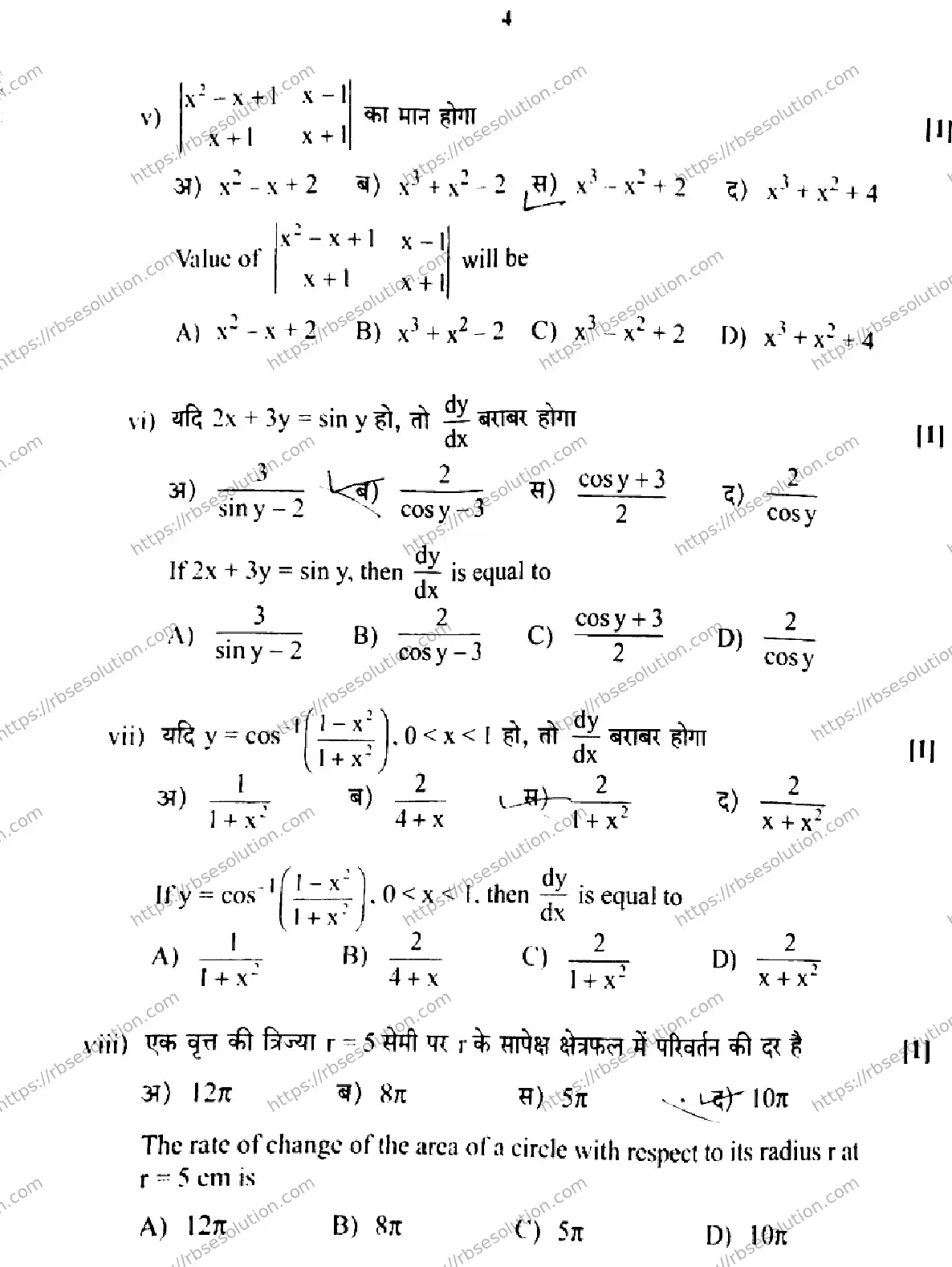
प्रश्न 5
का मान होगा:
- x² - x + 2
- x² + 2
- x² - x + 2
- x² + x + 4
सही विकल्प: (c) x² - x + 2
प्रश्न 6
यदि 2x + 3y = sin y हो, तो dy/dx बराबर होगा:
- 3/(sin y - 2)
- 2/(cos y - 3)
- 2/(cos y + 3)
- 2/cos y
सही विकल्प: (b) 2/(cos y - 3)
व्याख्या: 2x + 3y = sin y का अवकलन करने पर, 2 + 3(dy/dx) = cos y (dy/dx) ⇒ 2 = (cos y - 3)(dy/dx) ⇒ dy/dx = 2/(cos y - 3)
प्रश्न 7
यदि y = cos⁻¹( (1-x²)/(1+x²) ), 0 < x < 1 हो, तो dy/dx बराबर होगा:
- 1/(1+x²)
- 2/(1+x²)
- -2/(1+x²)
- 2/(x+x²)
सही विकल्प: (c) -2/(1+x²)
व्याख्या: y = cos⁻¹( (1-x²)/(1+x²) ) = 2 tan⁻¹ x (मानक सर्वसमिका), अतः dy/dx = 2/(1+x²) का ऋणात्मक मान लेने पर -2/(1+x²) प्राप्त होता है।
प्रश्न 8
एक वृत्त की त्रिज्या r = 5 सेमी पर r के सापेक्ष क्षेत्रफल में परिवर्तन की दर है:
- 10π
- 12π
- 8π
- 5π
सही विकल्प: (a) 10π
व्याख्या: वृत्त का क्षेत्रफल A = πr², dA/dr = 2πr, r = 5 पर dA/dr = 2π × 5 = 10π
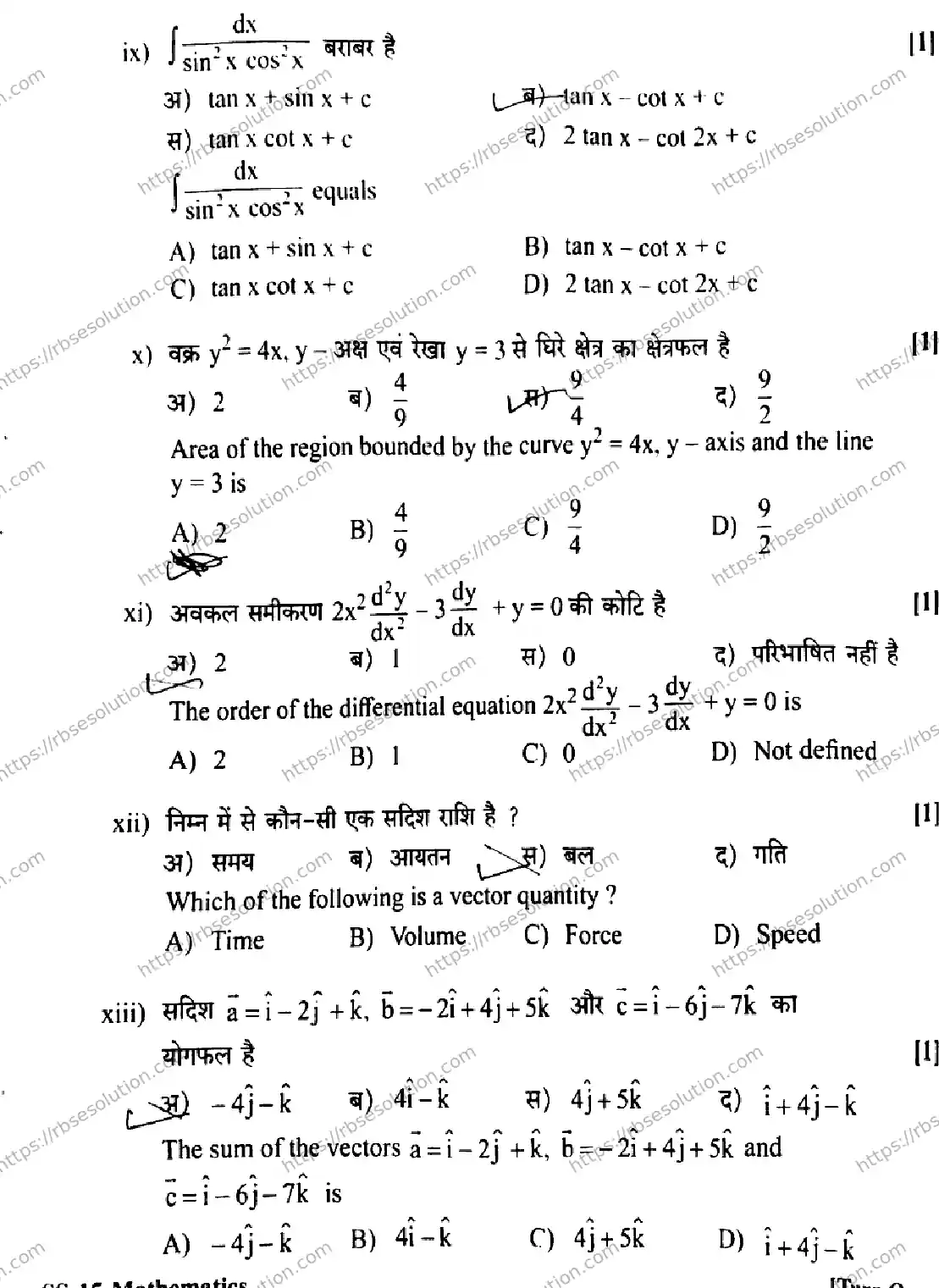
ix) \(\int \frac{dx}{\sin^2 x \cos^2 x}\) बराबर है
\(\int \frac{dx}{\sin^2 x \cos^2 x}\) equals
- \(\tan x + \sin x + c\)
- \(\tan x - \cot x + c\)
- \(\tan x \cot x + c\)
- \(2 \tan x - \cot 2x + c\)
सही उत्तर: B) \(\tan x - \cot x + c\)
व्याख्या: \(\int \frac{dx}{\sin^2 x \cos^2 x} = \int \frac{\sin^2 x + \cos^2 x}{\sin^2 x \cos^2 x} dx = \int (\sec^2 x + \csc^2 x) dx = \tan x - \cot x + c\).
x) वक्र \(y^2 = 4x\), \(y\)-अक्ष एवं रेखा \(y = 3\) से घिरे क्षेत्र का क्षेत्रफल है
Area of the region bounded by the curve \(y^2 = 4x\), \(y\)-axis and the line \(y = 3\) is
- 2
- \(\frac{9}{4}\)
- \(\frac{9}{2}\)
- \(\frac{4}{9}\)
सही उत्तर: B) \(\frac{9}{4}\)
व्याख्या: क्षेत्रफल = \(\int_{0}^{3} x \, dy = \int_{0}^{3} \frac{y^2}{4} dy = \frac{1}{4} \left[ \frac{y^3}{3} \right]_{0}^{3} = \frac{1}{4} \times \frac{27}{3} = \frac{9}{4}\) वर्ग इकाई।
xi) अवकल समीकरण \(2x \frac{d^2 y}{dx^2} + y = 0\) की कोटि है
The order of the differential equation \(2x \frac{d^2 y}{dx^2} + y = 0\) is
- 2
- 1
- 0
- Not defined
सही उत्तर: A) 2
व्याख्या: कोटि उच्चतम अवकलज की घात होती है। यहाँ उच्चतम अवकलज \(\frac{d^2 y}{dx^2}\) है, जिसकी कोटि 2 है।
xii) निम्न में से कौन-सी एक सदिश राशि है?
Which of the following is a vector quantity?
- समय (Time)
- आयतन (Volume)
- बल (Force)
- गति (Speed)
सही उत्तर: C) बल (Force)
व्याख्या: सदिश राशि में परिमाण और दिशा दोनों होते हैं। बल में दोनों होते हैं, जबकि समय, आयतन और गति में केवल परिमाण होता है (अदिश राशियाँ)।
xiii) सदिश \(\vec{a} = \hat{i} - 2\hat{j} + \hat{k}\), \(\vec{b} = -2\hat{i} + 4\hat{j} + 5\hat{k}\) और \(\vec{c} = \hat{i} - 6\hat{j} - 7\hat{k}\) का योगफल है
The sum of the vectors \(\vec{a} = \hat{i} - 2\hat{j} + \hat{k}\), \(\vec{b} = -2\hat{i} + 4\hat{j} + 5\hat{k}\) and \(\vec{c} = \hat{i} - 6\hat{j} - 7\hat{k}\) is
- \(-4\hat{j} - \hat{k}\)
- \(4\hat{i} - \hat{k}\)
- \(4\hat{j} + 5\hat{k}\)
- \(\hat{i} + 4\hat{j} - \hat{k}\)
सही उत्तर: A) \(-4\hat{j} - \hat{k}\)
व्याख्या: योगफल = \((\hat{i} - 2\hat{j} + \hat{k}) + (-2\hat{i} + 4\hat{j} + 5\hat{k}) + (\hat{i} - 6\hat{j} - 7\hat{k}) = (1-2+1)\hat{i} + (-2+4-6)\hat{j} + (1+5-7)\hat{k} = 0\hat{i} - 4\hat{j} - \hat{k} = -4\hat{j} - \hat{k}\).
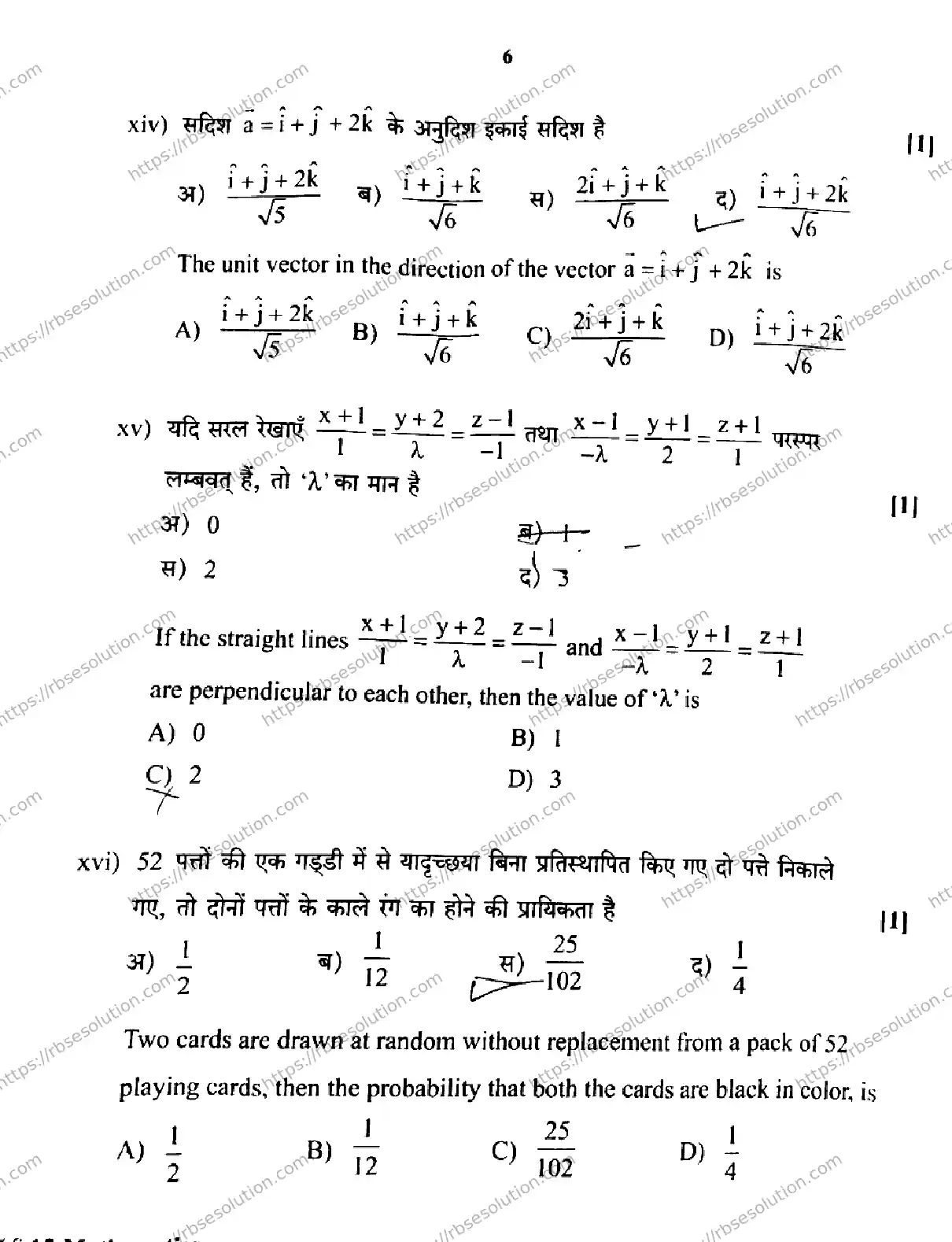
(xiv) सदिश a = i + j + 2k के अनुदिश इकाई सदिश है
The unit vector in the direction of the vector a = i + j + 2k is
- \(\frac{i+j+k}{\sqrt{5}}\)
- \(\frac{i+j+k}{\sqrt{6}}\)
- \(\frac{2i+2j+2k}{\sqrt{6}}\)
- \(\frac{i+j+2k}{\sqrt{6}}\)
(xv) यदि सरल रेखाएँ \(\frac{x+1}{2} = \frac{y+2}{1} = \frac{z-1}{\lambda}\) और \(\frac{x-1}{1} = \frac{y+1}{2} = \frac{z+1}{2}\) परस्पर लम्बवत् हैं, तो λ का मान है
If the straight lines \(\frac{x+1}{2} = \frac{y+2}{1} = \frac{z-1}{\lambda}\) and \(\frac{x-1}{1} = \frac{y+1}{2} = \frac{z+1}{2}\) are perpendicular to each other, then the value of λ is
- 0
- 1
- 2
- 3
(xvi) 52 पत्तों की एक गड्डी में से यादृच्छया बिना प्रतिस्थापित किए गए दो पत्ते निकाले जाते हैं, तो दोनों पत्तों के काले रंग का होने की प्रायिकता है
Two cards are drawn at random without replacement from a pack of 52 playing cards; then the probability that both the cards are black in color, is
- \(\frac{1}{2}\)
- \(\frac{25}{102}\)
- \(\frac{25}{102}\)
- \(\frac{1}{4}\)
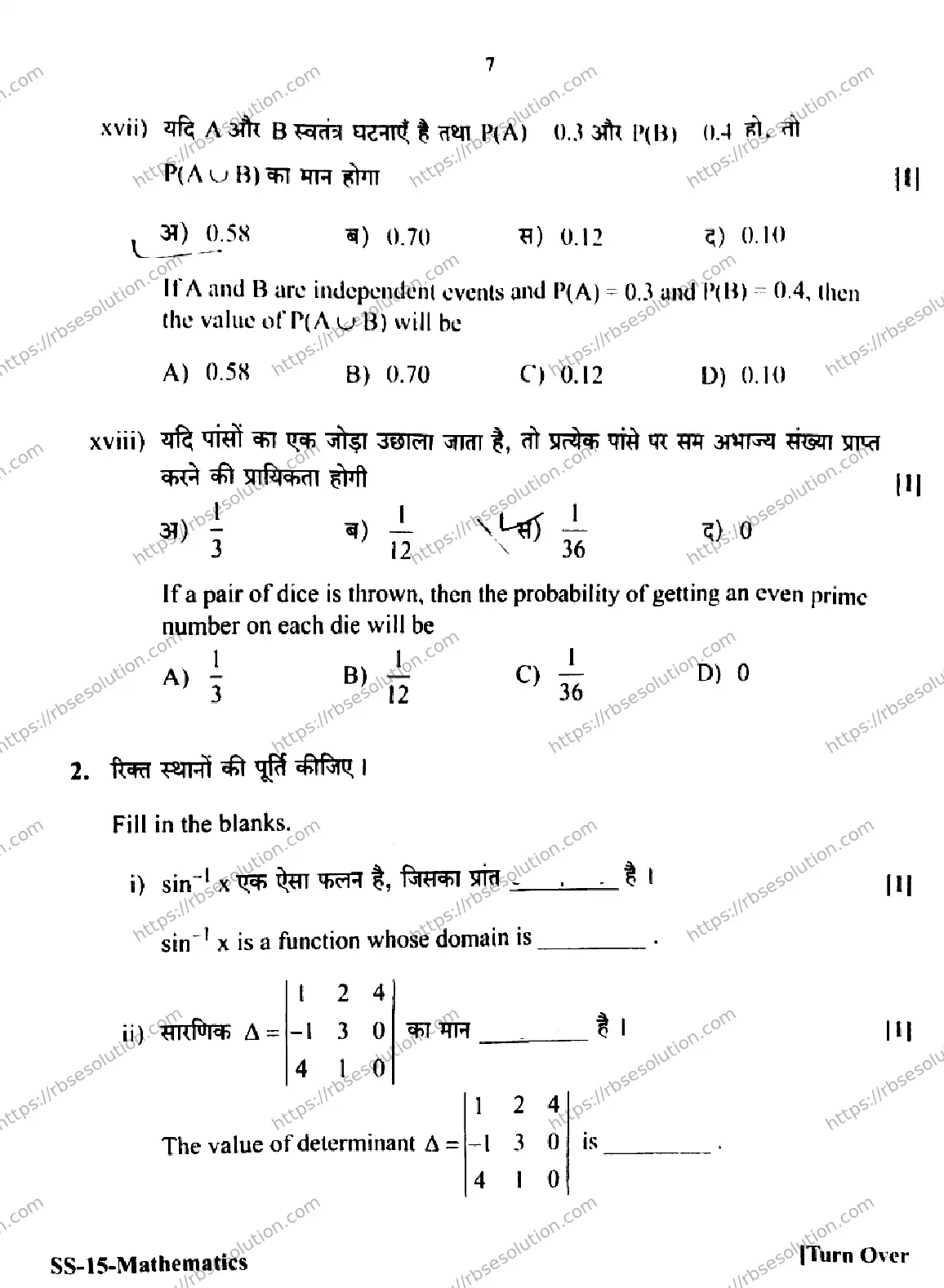
प्रश्न (xvii)
यदि A और B स्वतंत्र घटनाएँ हैं तथा P(A) = 0.3 और P(B) = 0.4, तो P(A ∪ B) का मान होगा:
- 0.58
- 0.70
- 0.12
- 0.10
हल: स्वतंत्र घटनाओं के लिए, P(A ∪ B) = P(A) + P(B) − P(A ∩ B) और P(A ∩ B) = P(A) × P(B).
P(A ∩ B) = 0.3 × 0.4 = 0.12
P(A ∪ B) = 0.3 + 0.4 − 0.12 = 0.58
सही उत्तर: A) 0.58
प्रश्न (xviii)
यदि पासों का एक जोड़ा उछाला जाता है, तो प्रत्येक पासे पर सम अभाज्य संख्या प्राप्त करने की प्रायिकता होगी:
- 1/3
- 1/2
- 1/36
- 0
हल: एक पासे पर सम अभाज्य संख्या केवल 2 है। एक पासे पर 2 आने की प्रायिकता = 1/6। दो पासों पर प्रत्येक पर 2 आने की प्रायिकता = (1/6) × (1/6) = 1/36।
सही उत्तर: C) 1/36
2. रिक्त स्थानों की पूर्ति कीजिए | Fill in the blanks.
(i) sin⁻¹ x एक ऐसा फलन है, जिसका प्रांत ______ है।
sin⁻¹ x is a function whose domain is ______.
उत्तर: [−1, 1]
(ii) सारणिक A =
| 1 2 4 |
| -1 3 0 |
| 4 -5 0 |
का मान ______ है।
The value of determinant A =
| 1 2 4 |
| -1 3 0 |
| 4 -5 0 |
is ______.
हल: सारणिक का विस्तार तीसरे स्तंभ के अनुदिश करने पर:
det(A) = 4 × [(-1)(-5) − (3)(4)] − 0 + 0 = 4 × (5 − 12) = 4 × (−7) = −28
उत्तर: −28
खंड-बी (Section-B)
-
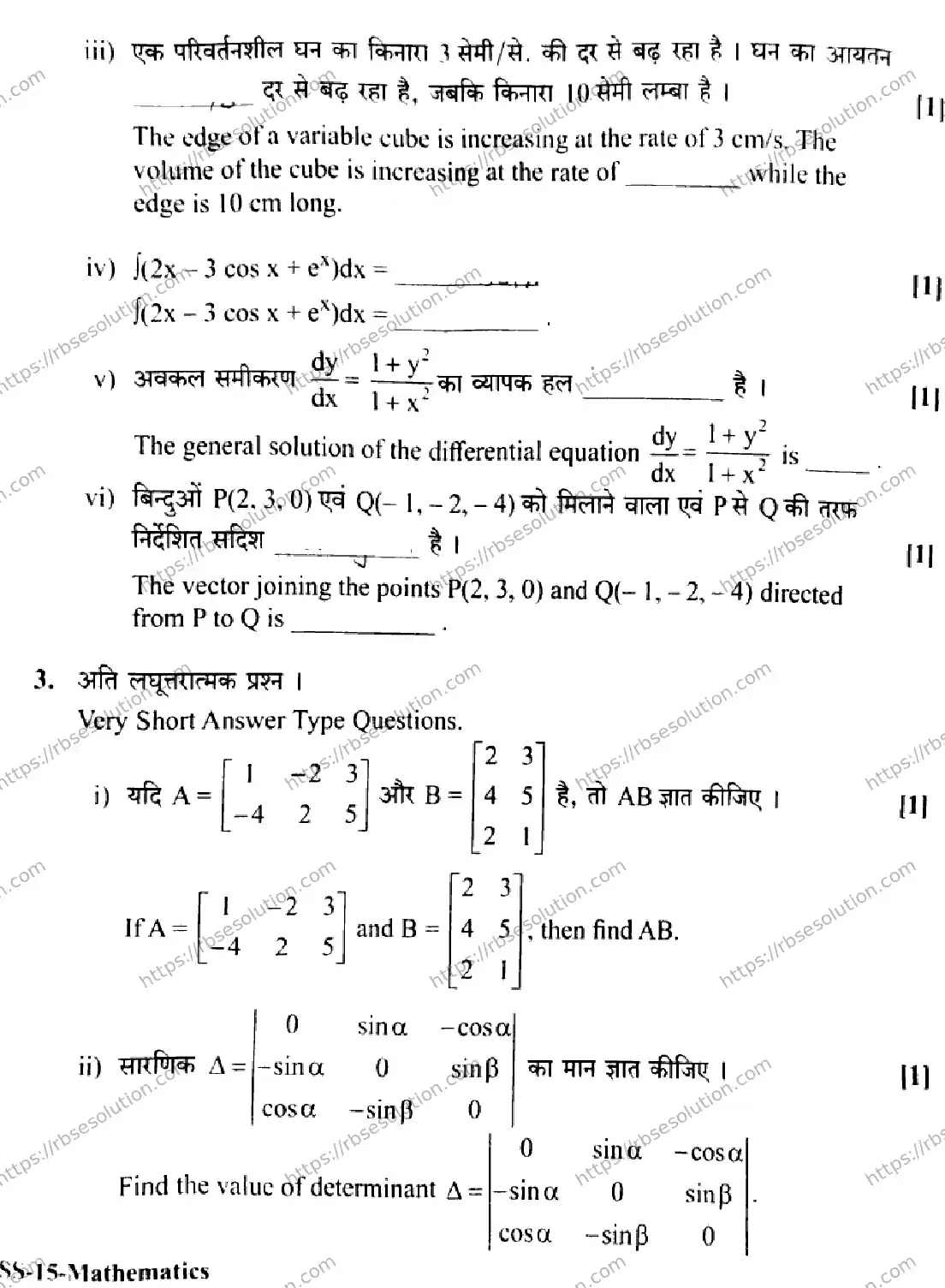
iii) एक परिवर्तनशील घन का किनारा 3 सेमी/से. की दर से बढ़ रहा है। घन का आयतन किस दर से बढ़ रहा है, जबकि किनारा 10 सेमी लम्बा है?
The edge of a variable cube is increasing at the rate of 3 cm/s. The volume of the cube is increasing at the rate of ______ while the edge is 10 cm long.
हल: माना घन का किनारा = x सेमी, आयतन = V = x³
दिया है: dx/dt = 3 सेमी/से.
dV/dt = d(x³)/dt = 3x² · dx/dt = 3x² × 3 = 9x²
जब x = 10 सेमी, dV/dt = 9 × (10)² = 9 × 100 = 900 सेमी³/से.
अतः आयतन 900 सेमी³/से. की दर से बढ़ रहा है।
-
iv) ∫(2x³ – 3 cos x + eˣ) dx = ______
हल: ∫(2x³ – 3 cos x + eˣ) dx = 2∫x³ dx – 3∫cos x dx + ∫eˣ dx
= 2·(x⁴/4) – 3·(sin x) + eˣ + C
= (x⁴/2) – 3 sin x + eˣ + C
-
v) अवकल समीकरण dy/dx = (1 + y²)/(1 + x²) का व्यापक हल है।
The general solution of the differential equation dy/dx = (1 + y²)/(1 + x²) is ______.
हल: dy/dx = (1 + y²)/(1 + x²)
⇒ dy/(1 + y²) = dx/(1 + x²)
दोनों पक्षों का समाकलन करने पर:
∫dy/(1 + y²) = ∫dx/(1 + x²)
⇒ tan⁻¹ y = tan⁻¹ x + C
⇒ tan⁻¹ y – tan⁻¹ x = C
⇒ tan⁻¹[(y – x)/(1 + xy)] = C
⇒ (y – x)/(1 + xy) = tan C = k (अचर)
⇒ y – x = k(1 + xy)
यही व्यापक हल है।
-
vi) बिन्दुओं P(2, 3, 0) एवं Q(-1, -2, -4) को मिलाने वाला एवं P से Q की तरफ़ निर्देशित सदिश ______ है।
The vector joining the points P(2, 3, 0) and Q(-1, -2, -4) directed from P to Q is ______.
हल: अभीष्ट सदिश = PQ = Q – P = (-1 – 2, -2 – 3, -4 – 0) = (-3, -5, -4)
∴ सदिश = -3î – 5ĵ – 4k̂
3. अति लघूत्तरात्मक प्रश्न
Very Short Answer Type Questions
-
i) यदि A = [2 3; 4 5] और B = [1 2; 3 4; 5 6] है, तो AB ज्ञात कीजिए।
If A = [2 3; 4 5] and B = [1 2; 3 4; 5 6], then find AB.
हल: A एक 2×2 आव्यूह है और B एक 3×2 आव्यूह है।
AB की परिभाषा के लिए, A के स्तंभों की संख्या (2) = B की पंक्तियों की संख्या (3) होनी चाहिए, जो यहाँ नहीं है।
अतः AB परिभाषित नहीं है।
-
ii) सारणिक A = |0 sinα -cosα; -sinα 0 sinβ; cosα -sinβ 0| का मान ज्ञात कीजिए।
Find the value of determinant A = |0 sinα -cosα; -sinα 0 sinβ; cosα -sinβ 0|.
हल: दिया गया सारणिक एक विषम सममित सारणिक है (विकर्ण के सापेक्ष aij = -aji) और इसकी कोटि 3 (विषम) है।
विषम कोटि के विषम सममित सारणिक का मान शून्य होता है।
∴ A = 0
iii)
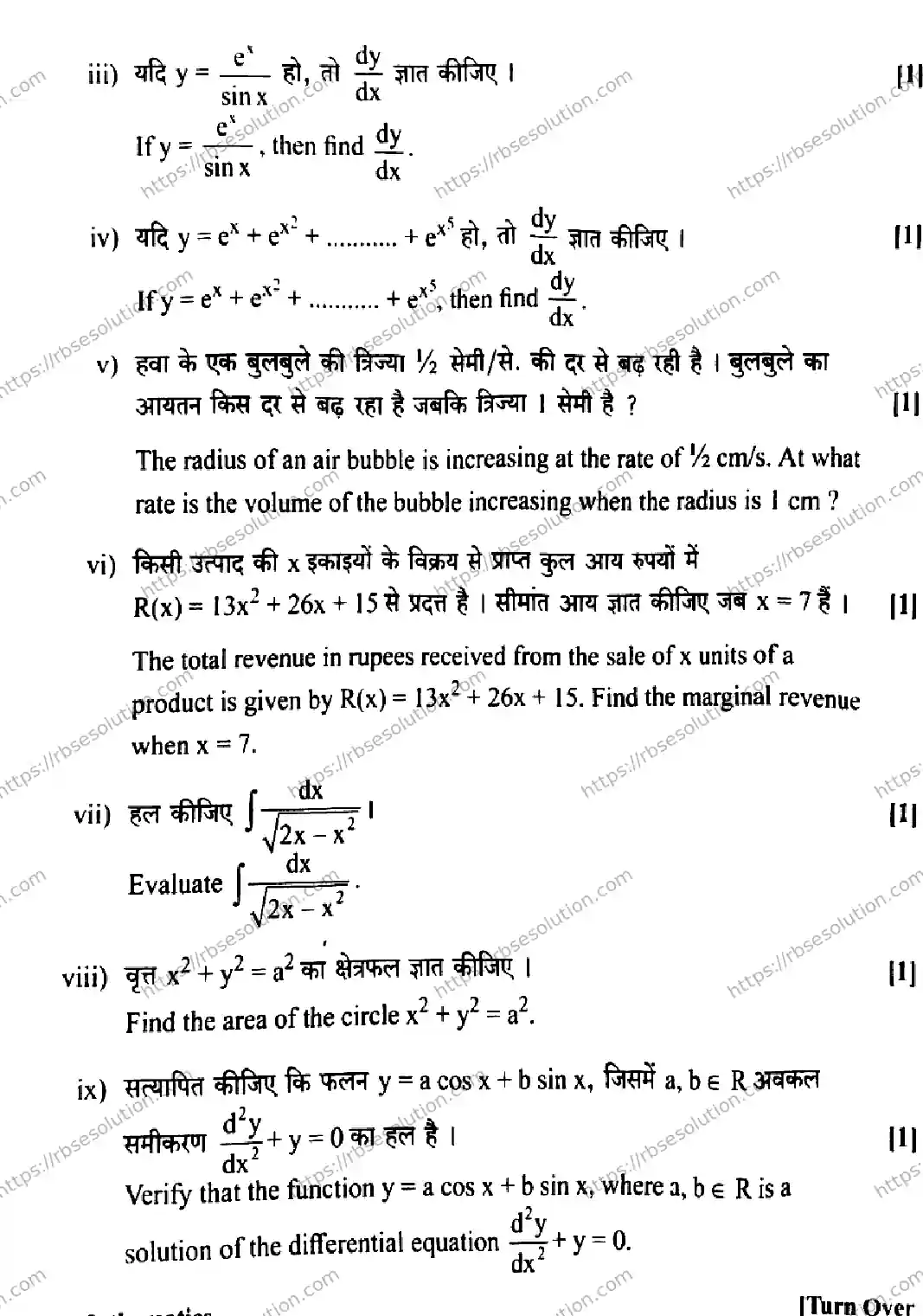
यदि \( y = \frac{1}{\sin x} \) हो, तो \(\frac{dy}{dx}\) ज्ञात कीजिए।
If \( y = \frac{1}{\sin x} \), then find \(\frac{dy}{dx}\).
Solution:
\( y = \frac{1}{\sin x} = \csc x \)
\(\frac{dy}{dx} = -\csc x \cot x\)
Or, \(\frac{dy}{dx} = -\frac{\cos x}{\sin^2 x}\)
iv)
यदि \( y = e^{5x} + e^{-5x} \) हो, तो \(\frac{dy}{dx}\) ज्ञात कीजिए।
If \( y = e^{5x} + e^{-5x} \), then find \(\frac{dy}{dx}\).
Solution:
\( y = e^{5x} + e^{-5x} \)
\(\frac{dy}{dx} = 5e^{5x} - 5e^{-5x}\)
\(\frac{dy}{dx} = 5(e^{5x} - e^{-5x})\)
v)
हवा के एक बुलबुले की त्रिज्या 4 सेमी/से. की दर से बढ़ रही है। बुलबुले का आयतन किस दर से बढ़ रहा है जबकि त्रिज्या 1 सेमी है?
The radius of an air bubble is increasing at the rate of 4 cm/s. At what rate is the volume of the bubble increasing when the radius is 1 cm?
Solution:
Given: \(\frac{dr}{dt} = 4\) cm/s, \(r = 1\) cm
Volume of sphere: \(V = \frac{4}{3}\pi r^3\)
\(\frac{dV}{dt} = \frac{dV}{dr} \cdot \frac{dr}{dt} = 4\pi r^2 \cdot \frac{dr}{dt}\)
\(\frac{dV}{dt} = 4\pi (1)^2 \cdot 4 = 16\pi\) cm³/s
Thus, the volume is increasing at the rate of \(16\pi\) cm³/s.
vi)
किसी उत्पाद की x इकाइयों के विक्रय से प्राप्त कुल आय रुपयों में \(R(x) = 3x^2 + 26x + 5\) से प्रदत्त है। सीमांत आय ज्ञात कीजिए जब \(x = 7\) है।
The total revenue in rupees received from the sale of x units of a product is given by \(R(x) = 3x^2 + 26x + 5\). Find the marginal revenue when \(x = 7\).
Solution:
Marginal revenue = \(\frac{dR}{dx}\)
\(R(x) = 3x^2 + 26x + 5\)
\(\frac{dR}{dx} = 6x + 26\)
At \(x = 7\): \(\frac{dR}{dx} = 6(7) + 26 = 42 + 26 = 68\)
Thus, marginal revenue is ₹68.
vii)
हल कीजिए: \(\int \frac{dx}{\sqrt{ax - x^2}}\)
Evaluate: \(\int \frac{dx}{\sqrt{ax - x^2}}\)
Solution:
\(\int \frac{dx}{\sqrt{ax - x^2}} = \int \frac{dx}{\sqrt{-(x^2 - ax)}}\)
Complete the square: \(x^2 - ax = \left(x - \frac{a}{2}\right)^2 - \frac{a^2}{4}\)
So, \(ax - x^2 = \frac{a^2}{4} - \left(x - \frac{a}{2}\right)^2\)
\(\int \frac{dx}{\sqrt{\frac{a^2}{4} - \left(x - \frac{a}{2}\right)^2}} = \sin^{-1}\left(\frac{x - \frac{a}{2}}{\frac{a}{2}}\right) + C\)
\(= \sin^{-1}\left(\frac{2x - a}{a}\right) + C\)
viii)
वृत्त \(x^2 + y^2 = a^2\) का क्षेत्रफल ज्ञात कीजिए।
Find the area of the circle \(x^2 + y^2 = a^2\).
Solution:
Area of circle = \(4 \times\) area of first quadrant
In first quadrant, \(y = \sqrt{a^2 - x^2}\), from \(x = 0\) to \(x = a\)
Area = \(4 \int_0^a \sqrt{a^2 - x^2} \, dx\)
\(= 4 \left[ \frac{x}{2}\sqrt{a^2 - x^2} + \frac{a^2}{2}\sin^{-1}\frac{x}{a} \right]_0^a\)
\(= 4 \left[ 0 + \frac{a^2}{2} \cdot \frac{\pi}{2} - 0 \right] = 4 \cdot \frac{\pi a^2}{4} = \pi a^2\)
Thus, area = \(\pi a^2\) square units.
ix)
सत्यापित कीजिए कि फलन \(y = a \cos x + b \sin x\), जिसमें \(a, b \in \mathbb{R}\), अवकल समीकरण \(\frac{d^2y}{dx^2} + y = 0\) का हल है।
Verify that the function \(y = a \cos x + b \sin x\), where \(a, b \in \mathbb{R}\), is a solution of the differential equation \(\frac{d^2y}{dx^2} + y = 0\).
Solution:
\(y = a \cos x + b \sin x\)
\(\frac{dy}{dx} = -a \sin x + b \cos x\)
\(\frac{d^2y}{dx^2} = -a \cos x - b \sin x = -(a \cos x + b \sin x) = -y\)
Thus, \(\frac{d^2y}{dx^2} + y = -y + y = 0\)
Hence, the function satisfies the differential equation.
प्रश्न (x)
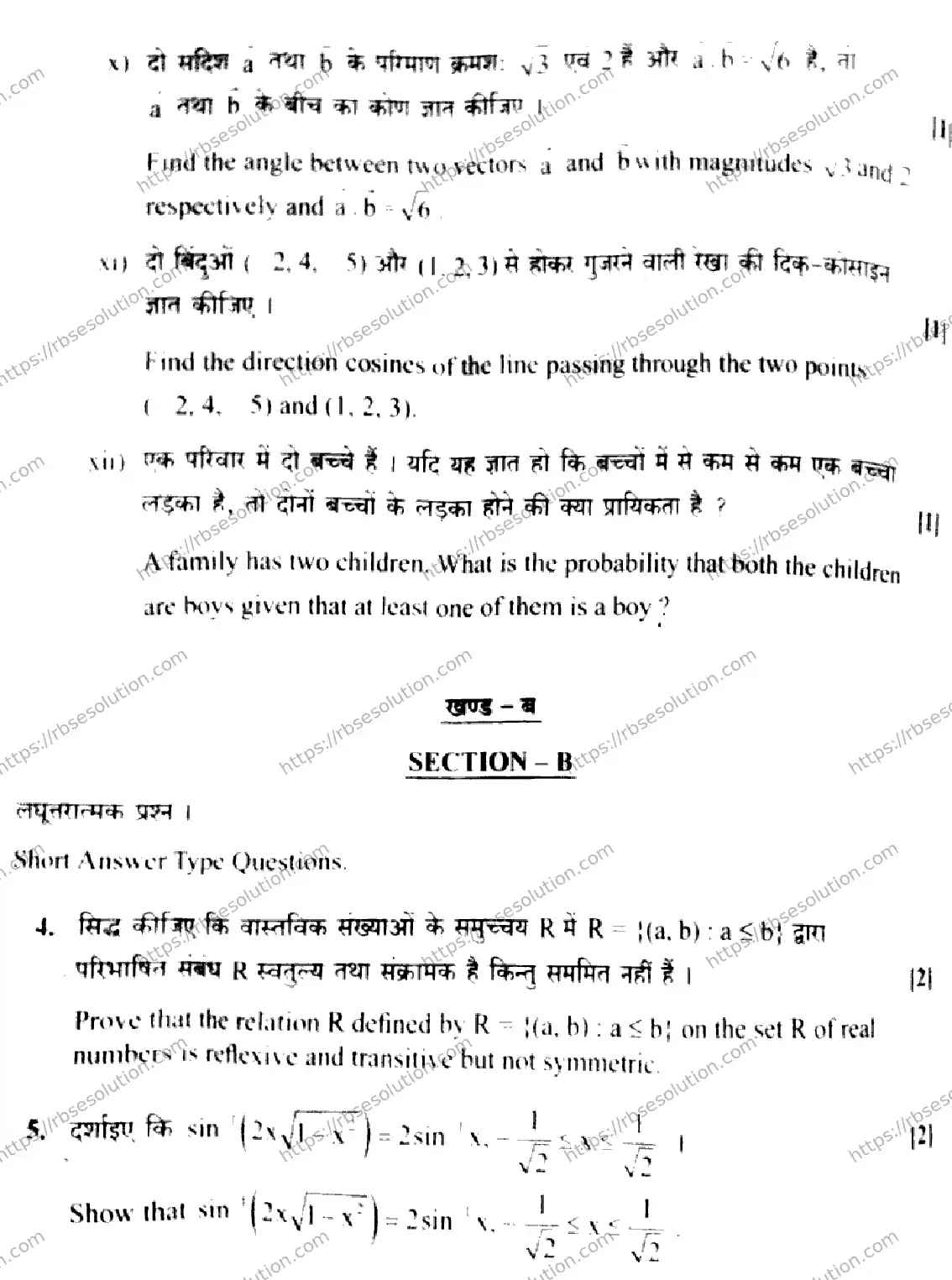
दो सदिशों a और b के परिमाण क्रमशः 3 और 5 हैं तथा a · b = √6 है, तो a और b के बीच का कोण ज्ञात कीजिए।
Find the angle between two vectors a and b with magnitudes 3 and 5 respectively and a · b = √6.
हल: माना कोण θ है। सदिशों के अदिश गुणनफल से,
a · b = |a| |b| cos θ
⇒ √6 = 3 × 5 × cos θ
⇒ cos θ = √6 / 15
⇒ θ = cos⁻¹(√6 / 15)
अतः अभीष्ट कोण cos⁻¹(√6 / 15) है।
प्रश्न (xi)
दो बिंदुओं (2, 4, 5) और (1, 2, 3) से होकर गुजरने वाली रेखा की दिक्-कोसाइन ज्ञात कीजिए।
Find the direction cosines of the line passing through the two points (2, 4, 5) and (1, 2, 3).
हल: माना बिंदु A(2, 4, 5) और B(1, 2, 3) हैं। रेखा AB के दिक्-अनुपात हैं:
1 – 2 = –1, 2 – 4 = –2, 3 – 5 = –2
अतः दिक्-अनुपात (–1, –2, –2) हैं।
दिक्-कोसाइन ज्ञात करने के लिए, मानक r = √[(-1)² + (-2)² + (-2)²] = √(1 + 4 + 4) = √9 = 3
दिक्-कोसाइन हैं: (–1/3, –2/3, –2/3)
अतः अभीष्ट दिक्-कोसाइन (–1/3, –2/3, –2/3) हैं।
प्रश्न (xii)
एक परिवार में दो बच्चे हैं। यदि यह ज्ञात हो कि उनमें से कम से कम एक बच्चा लड़का है, तो दोनों बच्चों के लड़का होने की क्या प्रायिकता है?
A family has two children. What is the probability that both the children are boys given that at least one of them is a boy?
हल: दो बच्चों के लिए प्रतिदर्श समष्टि: {BB, BG, GB, GG} (जहाँ B = लड़का, G = लड़की)
माना घटना A = दोनों बच्चे लड़के हैं = {BB}
घटना B = कम से कम एक लड़का है = {BB, BG, GB}
अभीष्ट प्रायिकता P(A|B) = P(A ∩ B) / P(B) = (1/4) / (3/4) = 1/3
अतः प्रायिकता 1/3 है।
खण्ड - ब
SECTION - B
लघूत्तरात्मक प्रश्न
Short Answer Type Questions
प्रश्न 4
सिद्ध कीजिए कि वास्तविक संख्याओं के समुच्चय R पर R = {(a, b) : a < b} द्वारा परिभाषित संबंध R स्वतुल्य तथा संक्रामक है किन्तु सममित नहीं है।
Prove that the relation R defined by R = {(a, b) : a < b} on the set R of real numbers is reflexive and transitive but not symmetric.
हल:
स्वतुल्यता: किसी भी वास्तविक संख्या a के लिए, a < a सत्य नहीं है, अतः (a, a) ∉ R। इसलिए R स्वतुल्य नहीं है। (प्रश्न में दिए गए अनुसार, यह स्वतुल्य नहीं है।)
सममितता: माना (a, b) ∈ R, अर्थात a < b। तब b < a सत्य नहीं है, अतः (b, a) ∉ R। इसलिए R सममित नहीं है।
संक्रामकता: माना (a, b) ∈ R और (b, c) ∈ R, अर्थात a < b और b < c। तब a < c, अतः (a, c) ∈ R। इसलिए R संक्रामक है।
अतः R स्वतुल्य नहीं है, सममित नहीं है, परंतु संक्रामक है।
प्रश्न 5
दर्शाइए कि sin⁻¹(2x√(1 – x²)) = 2 sin⁻¹ x, जहाँ |x| ≤ 1/√2
Show that sin⁻¹(2x√(1 – x²)) = 2 sin⁻¹ x, where |x| ≤ 1/√2
हल: माना x = sin θ, जहाँ θ ∈ [–π/2, π/2]। चूँकि |x| ≤ 1/√2, अतः θ ∈ [–π/4, π/4]।
बायाँ पक्ष: sin⁻¹(2 sin θ √(1 – sin² θ)) = sin⁻¹(2 sin θ cos θ) = sin⁻¹(sin 2θ)
चूँकि θ ∈ [–π/4, π/4], अतः 2θ ∈ [–π/2, π/2], जो sin⁻¹ का मुख्य मान परिसर है।
अतः sin⁻¹(sin 2θ) = 2θ = 2 sin⁻¹ x = दायाँ पक्ष।
इति सिद्धम्।
6.
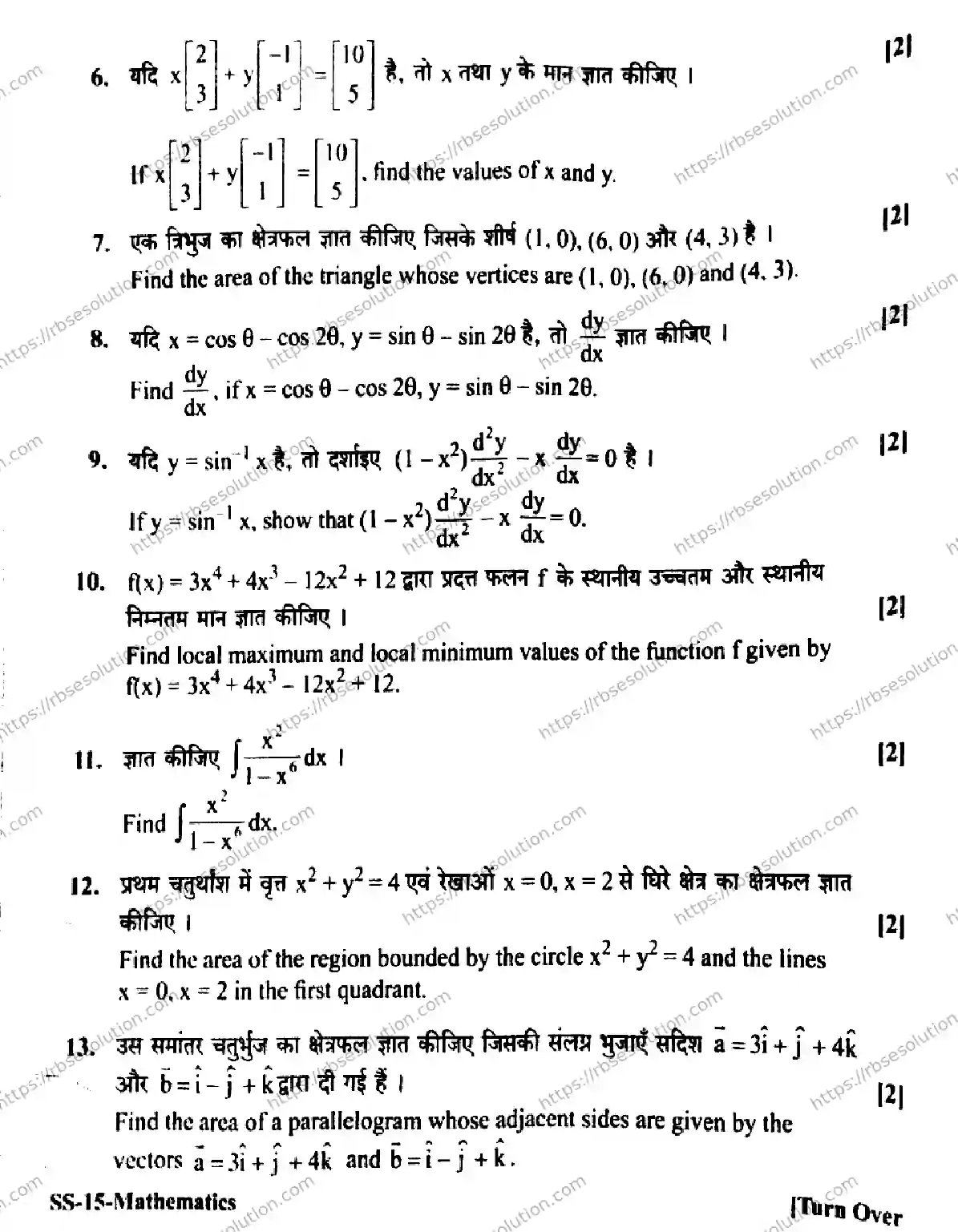
यदि x + y = i और x - y = 2 - i है, तो x तथा y के मान ज्ञात कीजिए।
If x + y = i and x - y = 2 - i, find the values of x and y.
हल: दोनों समीकरणों को जोड़ने पर:
(x + y) + (x - y) = i + (2 - i) ⇒ 2x = 2 ⇒ x = 1
अब, x + y = i ⇒ 1 + y = i ⇒ y = i - 1
अतः x = 1, y = -1 + i
7.
एक त्रिभुज का क्षेत्रफल ज्ञात कीजिए जिसके शीर्ष (1, 0), (6, 0) और (4, 3) हैं।
Find the area of the triangle whose vertices are (1, 0), (6, 0) and (4, 3).
हल: त्रिभुज का क्षेत्रफल = ½ |x₁(y₂ - y₃) + x₂(y₃ - y₁) + x₃(y₁ - y₂)|
= ½ |1(0 - 3) + 6(3 - 0) + 4(0 - 0)|
= ½ |(-3) + 18 + 0| = ½ × 15 = 7.5 वर्ग इकाई
अतः क्षेत्रफल = 7.5 वर्ग इकाई
8.
यदि x = cos θ - cos 2θ, y = sin θ - sin 2θ है, तो dy/dx ज्ञात कीजिए।
Find dy/dx, if x = cos θ - cos 2θ, y = sin θ - sin 2θ.
हल: dx/dθ = -sin θ + 2 sin 2θ = 2 sin 2θ - sin θ
dy/dθ = cos θ - 2 cos 2θ
dy/dx = (dy/dθ)/(dx/dθ) = (cos θ - 2 cos 2θ)/(2 sin 2θ - sin θ)
9.
यदि y = sin⁻¹ x है, तो दर्शाइए (1 - x²) d²y/dx² - x dy/dx = 0.
If y = sin⁻¹ x, show that (1 - x²) d²y/dx² - x dy/dx = 0.
हल: y = sin⁻¹ x ⇒ dy/dx = 1/√(1 - x²)
पुनः अवकलन करने पर:
d²y/dx² = d/dx [1/√(1 - x²)] = -½(1 - x²)^(-3/2) × (-2x) = x/(1 - x²)^(3/2)
अब, (1 - x²) d²y/dx² - x dy/dx = (1 - x²) × x/(1 - x²)^(3/2) - x × 1/√(1 - x²)
= x/√(1 - x²) - x/√(1 - x²) = 0
अतः सिद्ध हुआ।
10.
f(x) = 3x⁴ + 4x³ - 12x² + 2 द्वारा प्रदत्त फलन f के स्थानीय उच्चतम और स्थानीय निम्नतम मान ज्ञात कीजिए।
Find local maximum and local minimum values of the function f given by f(x) = 3x⁴ + 4x³ - 12x² + 2.
हल: f'(x) = 12x³ + 12x² - 24x = 12x(x² + x - 2) = 12x(x + 2)(x - 1)
f'(x) = 0 ⇒ x = 0, x = -2, x = 1
f''(x) = 36x² + 24x - 24
x = -2 पर: f''(-2) = 36(4) + 24(-2) - 24 = 144 - 48 - 24 = 72 > 0 ⇒ स्थानीय निम्नतम
f(-2) = 3(16) + 4(-8) - 12(4) + 2 = 48 - 32 - 48 + 2 = -30
x = 0 पर: f''(0) = -24 < 0 ⇒ स्थानीय उच्चतम
f(0) = 2
x = 1 पर: f''(1) = 36 + 24 - 24 = 36 > 0 ⇒ स्थानीय निम्नतम
f(1) = 3 + 4 - 12 + 2 = -3
अतः स्थानीय उच्चतम मान = 2 (x = 0 पर), स्थानीय निम्नतम मान = -30 (x = -2 पर) और -3 (x = 1 पर)
12.
प्रथम चतुर्थाश में वृत्त x² + y² = 4 एवं रेखाओं x = 0, x = 2 से घिरे क्षेत्र का क्षेत्रफल ज्ञात कीजिए।
Find the area of the region bounded by the circle x² + y² = 4 and the lines x = 0, x = 2 in the first quadrant.
हल: वृत्त का समीकरण: x² + y² = 4 ⇒ y = √(4 - x²) (प्रथम चतुर्थाश में)
अभीष्ट क्षेत्रफल = ∫₀² √(4 - x²) dx
= [x/2 √(4 - x²) + 2 sin⁻¹(x/2)]₀²
= [2/2 √(4 - 4) + 2 sin⁻¹(1)] - [0 + 2 sin⁻¹(0)]
= 0 + 2(π/2) - 0 = π वर्ग इकाई
अतः क्षेत्रफल = π वर्ग इकाई
13.
उस समांतर चतुर्भुज का क्षेत्रफल ज्ञात कीजिए जिसकी संलग्न भुजाएँ सदिश a = 3i + j + 4k और b = i - j + k द्वारा दी गई हैं।
Find the area of a parallelogram whose adjacent sides are given by the vectors a = 3i + j + 4k and b = i - j + k.
हल: समांतर चतुर्भुज का क्षेत्रफल = |a × b|
a × b = |i j k; 3 1 4; 1 -1 1|
= i(1×1 - 4×(-1)) - j(3×1 - 4×1) + k(3×(-1) - 1×1)
= i(1 + 4) - j(3 - 4) + k(-3 - 1)
= 5i + j - 4k
|a × b| = √(5² + 1² + (-4)²) = √(25 + 1 + 16) = √42
अतः क्षेत्रफल = √42 वर्ग इकाई
खण्ड -स / SECTION - C
दीर्घ उत्तरात्मक प्रश्न :
Long Answer Type Questions :
प्रश्न 14.
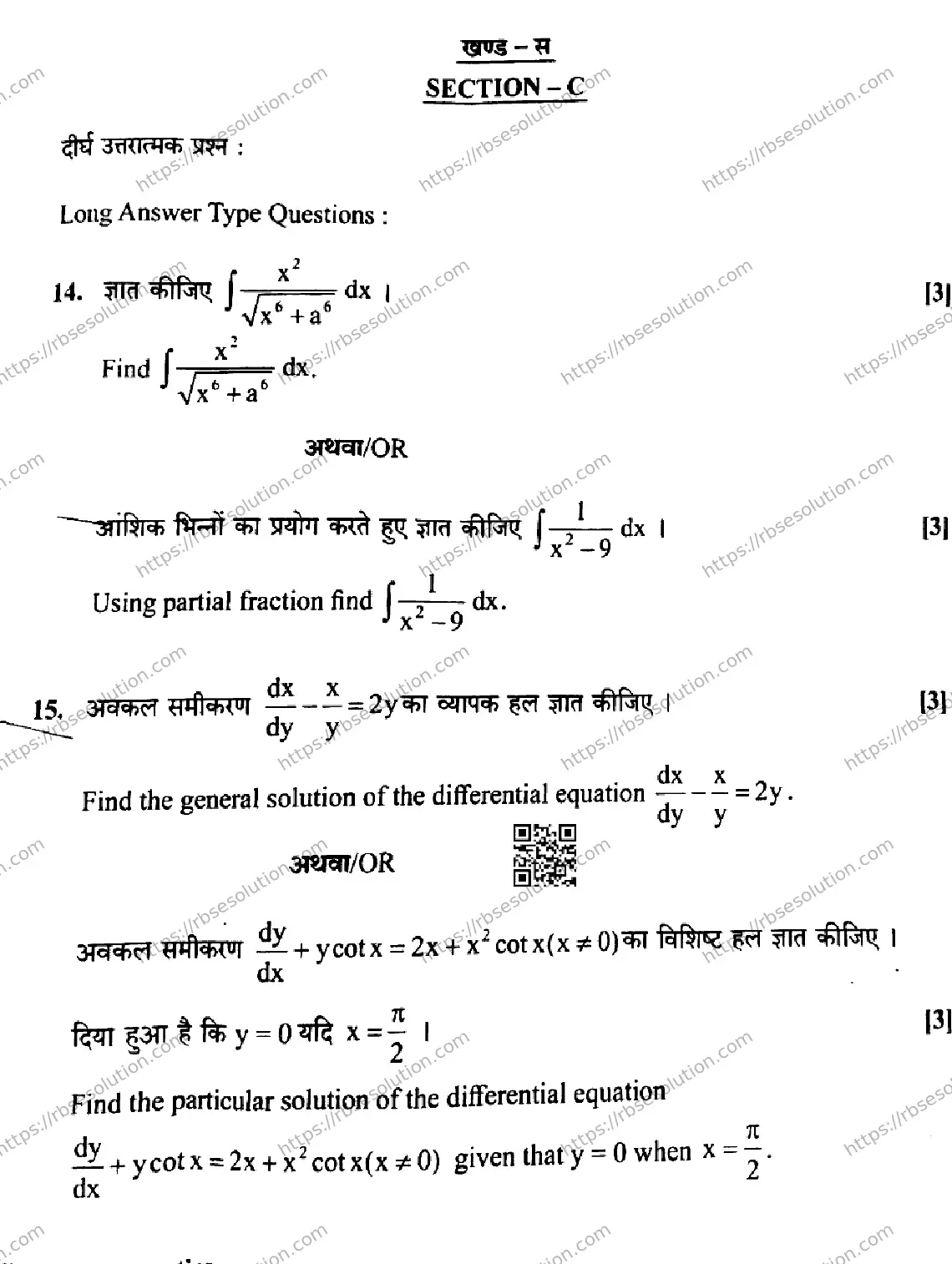
ज्ञात कीजिए : ∫ √(1 + x²) dx
Find ∫ √(1 + x²) dx.
हल / Solution:
हम जानते हैं कि ∫ √(a² + x²) dx = (x/2) √(a² + x²) + (a²/2) log | x + √(a² + x²) | + C
यहाँ a = 1, अतः
∫ √(1 + x²) dx = (x/2) √(1 + x²) + (1/2) log | x + √(1 + x²) | + C
अथवा / OR
आंशिक भिन्नों का प्रयोग करते हुए ज्ञात कीजिए : ∫ 1/(x² + 9x + 8) dx
Using partial fraction, find ∫ 1/(x² + 9x + 8) dx.
हल / Solution:
सर्वप्रथम, x² + 9x + 8 = (x + 1)(x + 8)
माना 1/(x² + 9x + 8) = A/(x + 1) + B/(x + 8)
⇒ 1 = A(x + 8) + B(x + 1)
x = -1 रखने पर: 1 = A(7) ⇒ A = 1/7
x = -8 रखने पर: 1 = B(-7) ⇒ B = -1/7
अतः ∫ 1/(x² + 9x + 8) dx = (1/7) ∫ [1/(x + 1) - 1/(x + 8)] dx
= (1/7) [log |x + 1| - log |x + 8|] + C
= (1/7) log |(x + 1)/(x + 8)| + C
प्रश्न 15.
अवकल समीकरण dy/dx = y/x + 2 का व्यापक हल ज्ञात कीजिए। [3]
Find the general solution of the differential equation dy/dx = y/x + 2.
हल / Solution:
दिया है: dy/dx - y/x = 2
यह एक रैखिक अवकल समीकरण है। यहाँ P = -1/x, Q = 2
समाकलन गुणक (I.F.) = e^∫ P dx = e^∫ (-1/x) dx = e^{-log x} = 1/x
व्यापक हल: y * (1/x) = ∫ 2 * (1/x) dx + C
⇒ y/x = 2 log |x| + C
⇒ y = 2x log |x| + Cx
अथवा / OR
अवकल समीकरण dy/dx + y cot x = 2x + x² cot x (x ≠ 0) का विशिष्ट हल ज्ञात कीजिए। दिया हुआ है कि y = 0 जब x = π/2। [3]
Find the particular solution of the differential equation dy/dx + y cot x = 2x + x² cot x (x ≠ 0) given that y = 0 when x = π/2.
हल / Solution:
दिया है: dy/dx + y cot x = 2x + x² cot x
यहाँ P = cot x, Q = 2x + x² cot x
समाकलन गुणक (I.F.) = e^∫ cot x dx = e^{log sin x} = sin x
व्यापक हल: y * sin x = ∫ (2x + x² cot x) sin x dx + C
⇒ y sin x = ∫ (2x sin x + x² cos x) dx + C
⇒ y sin x = ∫ 2x sin x dx + ∫ x² cos x dx + C
पहले समाकलन के लिए खण्डशः समाकलन का प्रयोग करें:
∫ 2x sin x dx = -2x cos x + 2 sin x
दूसरे समाकलन के लिए खण्डशः समाकलन का प्रयोग करें:
∫ x² cos x dx = x² sin x - ∫ 2x sin x dx = x² sin x + 2x cos x - 2 sin x
अतः y sin x = (-2x cos x + 2 sin x) + (x² sin x + 2x cos x - 2 sin x) + C
⇒ y sin x = x² sin x + C
⇒ y = x² + C cosec x
अब, y = 0 जब x = π/2 रखने पर:
0 = (π/2)² + C * 1 ⇒ C = -π²/4
अतः विशिष्ट हल: y = x² - (π²/4) cosec x
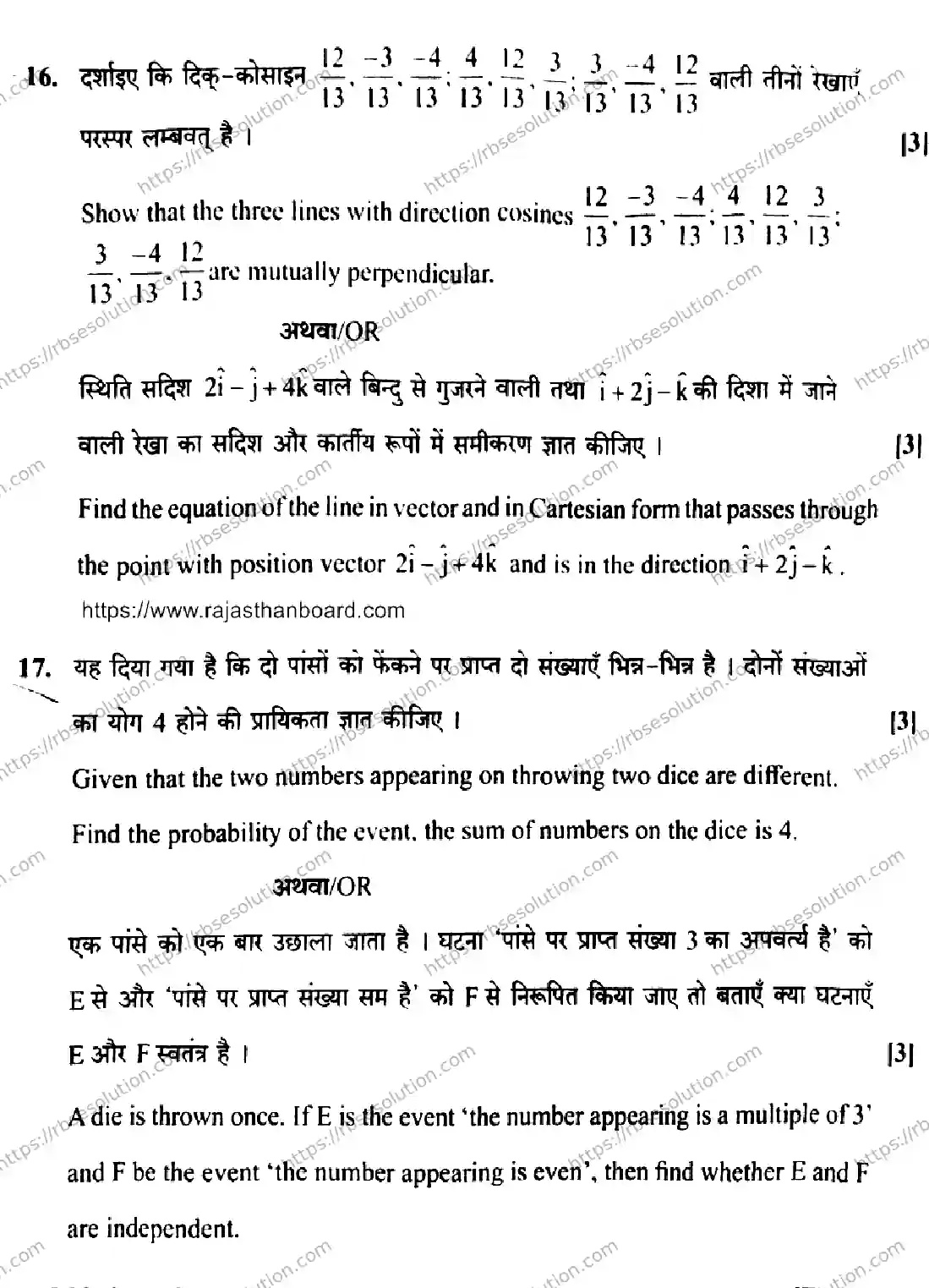
16. दर्शाइए कि दिक्-कोसाइन \(\frac{2}{3}, -\frac{1}{3}, -\frac{2}{3}\); \(\frac{1}{3}, \frac{2}{3}, -\frac{2}{3}\); \(\frac{2}{3}, \frac{2}{3}, \frac{1}{3}\) वाली तीनों रेखाएँ परस्पर लम्बवत् हैं।
Show that the three lines with direction cosines \(\frac{2}{3}, -\frac{1}{3}, -\frac{2}{3}\); \(\frac{1}{3}, \frac{2}{3}, -\frac{2}{3}\); \(\frac{2}{3}, \frac{2}{3}, \frac{1}{3}\) are mutually perpendicular.
हल: माना पहली रेखा की दिक्-कोसाइन \(l_1 = \frac{2}{3}, m_1 = -\frac{1}{3}, n_1 = -\frac{2}{3}\) हैं।
दूसरी रेखा की दिक्-कोसाइन \(l_2 = \frac{1}{3}, m_2 = \frac{2}{3}, n_2 = -\frac{2}{3}\) हैं।
तीसरी रेखा की दिक्-कोसाइन \(l_3 = \frac{2}{3}, m_3 = \frac{2}{3}, n_3 = \frac{1}{3}\) हैं।
पहली और दूसरी रेखा के लिए: \(l_1 l_2 + m_1 m_2 + n_1 n_2 = \frac{2}{3} \times \frac{1}{3} + (-\frac{1}{3}) \times \frac{2}{3} + (-\frac{2}{3}) \times (-\frac{2}{3}) = \frac{2}{9} - \frac{2}{9} + \frac{4}{9} = \frac{4}{9} \neq 0\)
पहली और तीसरी रेखा के लिए: \(l_1 l_3 + m_1 m_3 + n_1 n_3 = \frac{2}{3} \times \frac{2}{3} + (-\frac{1}{3}) \times \frac{2}{3} + (-\frac{2}{3}) \times \frac{1}{3} = \frac{4}{9} - \frac{2}{9} - \frac{2}{9} = 0\)
दूसरी और तीसरी रेखा के लिए: \(l_2 l_3 + m_2 m_3 + n_2 n_3 = \frac{1}{3} \times \frac{2}{3} + \frac{2}{3} \times \frac{2}{3} + (-\frac{2}{3}) \times \frac{1}{3} = \frac{2}{9} + \frac{4}{9} - \frac{2}{9} = \frac{4}{9} \neq 0\)
चूँकि पहली और तीसरी रेखा के लिए दिक्-कोसाइनों का योग शून्य है, अतः ये दोनों रेखाएँ परस्पर लम्बवत् हैं। दूसरी रेखा इनमें से किसी के भी लम्बवत् नहीं है।
नोट: प्रश्न में दी गई दिक्-कोसाइनों के अनुसार, केवल पहली और तीसरी रेखा परस्पर लम्बवत् हैं।
अथवा/OR
स्थिति सदिश \(2\hat{i} - \hat{j} + 4\hat{k}\) वाले बिन्दु से गुजरने वाली \(\hat{i} + 2\hat{j} - \hat{k}\) की दिशा में जाने वाली रेखा का सदिश और कार्तीय रूपों में समीकरण ज्ञात कीजिए।
Find the equation of the line in vector and in Cartesian form that passes through the point with position vector \(2\hat{i} - \hat{j} + 4\hat{k}\) and is in the direction \(\hat{i} + 2\hat{j} - \hat{k}\).
हल: दिया है, बिन्दु का स्थिति सदिश \(\vec{a} = 2\hat{i} - \hat{j} + 4\hat{k}\) और दिशा सदिश \(\vec{b} = \hat{i} + 2\hat{j} - \hat{k}\) है।
सदिश रूप: रेखा का सदिश समीकरण \(\vec{r} = \vec{a} + \lambda \vec{b}\) है, जहाँ \(\lambda\) एक अदिश है।
अतः \(\vec{r} = (2\hat{i} - \hat{j} + 4\hat{k}) + \lambda (\hat{i} + 2\hat{j} - \hat{k})\)
कार्तीय रूप: माना \(\vec{r} = x\hat{i} + y\hat{j} + z\hat{k}\), तब
\(x\hat{i} + y\hat{j} + z\hat{k} = (2 + \lambda)\hat{i} + (-1 + 2\lambda)\hat{j} + (4 - \lambda)\hat{k}\)
अतः \(x = 2 + \lambda\), \(y = -1 + 2\lambda\), \(z = 4 - \lambda\)
\(\lambda\) को हटाने पर, \(\frac{x - 2}{1} = \frac{y + 1}{2} = \frac{z - 4}{-1}\)
यही अभीष्ट कार्तीय समीकरण है।
17. यह दिया गया है कि दो पाँसों को फेंकने पर प्राप्त दो संख्याएँ भिन्न-भिन्न हैं। दोनों संख्याओं का योग 4 होने की प्रायिकता ज्ञात कीजिए।
Given that the two numbers appearing on throwing two dice are different. Find the probability of the event that the sum of numbers on the dice is 4.
हल: दो पाँसे फेंकने पर कुल संभावित परिणाम = 6 × 6 = 36
माना घटना A: दोनों संख्याएँ भिन्न हैं।
घटना B: दोनों संख्याओं का योग 4 है।
हमें \(P(B|A)\) ज्ञात करना है।
घटना A के अनुकूल परिणाम = कुल परिणाम - समान संख्याओं वाले परिणाम = 36 - 6 = 30
अतः \(P(A) = \frac{30}{36} = \frac{5}{6}\)
घटना A ∩ B: दोनों संख्याएँ भिन्न हैं और योग 4 है।
इसके अनुकूल परिणाम: (1,3), (3,1), (2,2) लेकिन (2,2) में संख्याएँ समान हैं, अतः इसे छोड़ देंगे।
अतः अनुकूल परिणाम = (1,3) और (3,1) = 2
\(P(A \cap B) = \frac{2}{36} = \frac{1}{18}\)
अतः अभीष्ट प्रायिकता: \(P(B|A) = \frac{P(A \cap B)}{P(A)} = \frac{1/18}{5/6} = \frac{1}{18} \times \frac{6}{5} = \frac{1}{15}\)
अथवा/OR
एक पाँसे को एक बार उछाला जाता है। घटना "पाँसे पर प्राप्त संख्या 3 का गुणज है" को E और "पाँसे पर प्राप्त संख्या सम है" को F निरूपित किया जाए तो बताएँ क्या घटनाएँ E और F स्वतंत्र हैं?
A die is thrown once. If E be the event 'the number appearing is a multiple of 3' and F be the event 'the number appearing is even', then find whether E and F are independent.
हल: एक पाँसा फेंकने पर प्रतिदर्श समष्टि S = {1, 2, 3, 4, 5, 6}
घटना E: संख्या 3 का गुणज है = {3, 6}
\(P(E) = \frac{2}{6} = \frac{1}{3}\)
घटना F: संख्या सम है = {2, 4, 6}
\(P(F) = \frac{3}{6} = \frac{1}{2}\)
घटना E ∩ F: संख्या 3 का गुणज और सम है = {6}
\(P(E \cap F) = \frac{1}{6}\)
अब, \(P(E) \times P(F) = \frac{1}{3} \times \frac{1}{2} = \frac{1}{6}\)
चूँकि \(P(E \cap F) = P(E) \times P(F)\), अतः घटनाएँ E और F स्वतंत्र हैं।
खण्ड - द
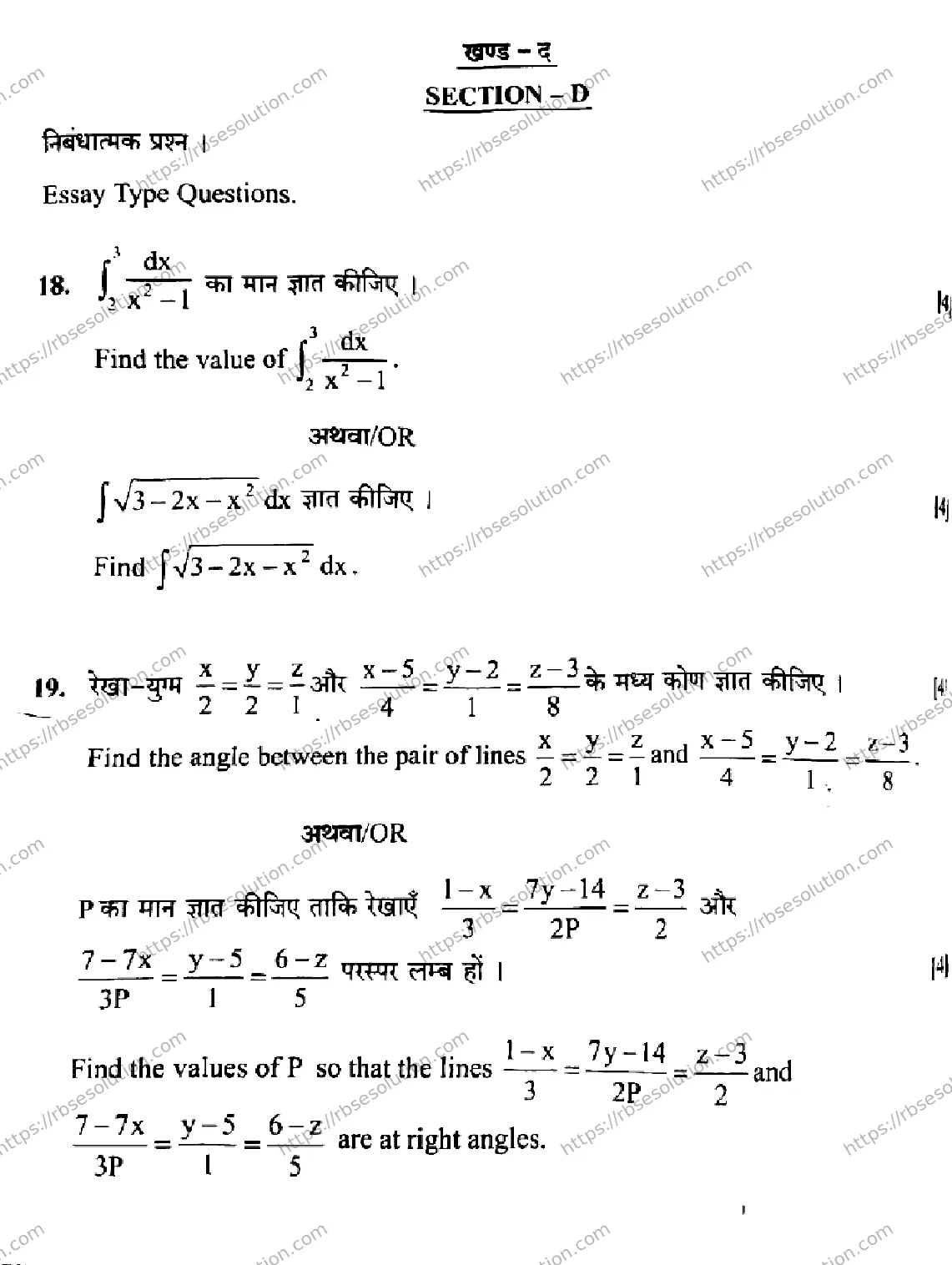
SECTION - D
निबंधात्मक प्रश्न / Essay Type Questions
-
\(\int \frac{3x \, dx}{2x - 1}\) का मान ज्ञात कीजिए।
Find the value of \(\int \frac{3x \, dx}{2x - 1}\).
हल / Solution:
\(\int \frac{3x}{2x-1} dx\)
भाग विधि से: \(\frac{3x}{2x-1} = \frac{3}{2} + \frac{3}{2(2x-1)}\)
अतः \(\int \frac{3x}{2x-1} dx = \int \left( \frac{3}{2} + \frac{3}{2(2x-1)} \right) dx\)
\(= \frac{3}{2}x + \frac{3}{4} \ln|2x-1| + C\)
उत्तर: \(\frac{3}{2}x + \frac{3}{4} \ln|2x-1| + C\)
अथवा / OR
\(\int \sqrt{3 - 2x - x^2} \, dx\) ज्ञात कीजिए।
Find \(\int \sqrt{3 - 2x - x^2} \, dx\).
हल / Solution:
\(\int \sqrt{3 - 2x - x^2} dx = \int \sqrt{4 - (x+1)^2} dx\)
मानक सूत्र \(\int \sqrt{a^2 - x^2} dx = \frac{x}{2}\sqrt{a^2 - x^2} + \frac{a^2}{2}\sin^{-1}\frac{x}{a} + C\) का प्रयोग करते हुए:
यहाँ \(a = 2\), \(x = x+1\)
\(\int \sqrt{4 - (x+1)^2} dx = \frac{x+1}{2}\sqrt{4 - (x+1)^2} + \frac{4}{2}\sin^{-1}\frac{x+1}{2} + C\)
\(= \frac{x+1}{2}\sqrt{3 - 2x - x^2} + 2\sin^{-1}\frac{x+1}{2} + C\)
उत्तर: \(\frac{x+1}{2}\sqrt{3 - 2x - x^2} + 2\sin^{-1}\frac{x+1}{2} + C\)
-
रेखाओं \(\frac{x}{2} = \frac{y}{2} = \frac{z}{1}\) और \(\frac{x-5}{4} = \frac{y-2}{1} = \frac{z-3}{8}\) के मध्य कोण ज्ञात कीजिए।
Find the angle between the pair of lines \(\frac{x}{2} = \frac{y}{2} = \frac{z}{1}\) and \(\frac{x-5}{4} = \frac{y-2}{1} = \frac{z-3}{8}\).
हल / Solution:
पहली रेखा के दिक्-अनुपात: \(a_1 = 2, b_1 = 2, c_1 = 1\)
दूसरी रेखा के दिक्-अनुपात: \(a_2 = 4, b_2 = 1, c_2 = 8\)
दो रेखाओं के बीच कोण \(\theta\) का सूत्र:
\(\cos \theta = \frac{a_1 a_2 + b_1 b_2 + c_1 c_2}{\sqrt{a_1^2 + b_1^2 + c_1^2} \sqrt{a_2^2 + b_2^2 + c_2^2}}\)
\(\cos \theta = \frac{2 \times 4 + 2 \times 1 + 1 \times 8}{\sqrt{4+4+1} \sqrt{16+1+64}} = \frac{8+2+8}{\sqrt{9} \sqrt{81}} = \frac{18}{3 \times 9} = \frac{18}{27} = \frac{2}{3}\)
\(\theta = \cos^{-1}\left(\frac{2}{3}\right)\)
उत्तर: \(\theta = \cos^{-1}\left(\frac{2}{3}\right)\)
अथवा / OR
\(p\) का मान ज्ञात कीजिए ताकि रेखाएँ \(\frac{1-x}{3} = \frac{7y-14}{2p} = \frac{z-3}{2}\) और \(\frac{7-7x}{3p} = \frac{y-5}{1} = \frac{6-z}{5}\) परस्पर लम्ब हों।
Find the values of \(p\) so that the lines \(\frac{1-x}{3} = \frac{7y-14}{2p} = \frac{z-3}{2}\) and \(\frac{7-7x}{3p} = \frac{y-5}{1} = \frac{6-z}{5}\) are at right angles.
हल / Solution:
पहली रेखा को मानक रूप में लिखें:
\(\frac{x-1}{-3} = \frac{y-2}{\frac{2p}{7}} = \frac{z-3}{2}\)
दिक्-अनुपात: \(a_1 = -3, b_1 = \frac{2p}{7}, c_1 = 2\)
दूसरी रेखा को मानक रूप में लिखें:
\(\frac{x-1}{-\frac{3p}{7}} = \frac{y-5}{1} = \frac{z-6}{-5}\)
दिक्-अनुपात: \(a_2 = -\frac{3p}{7}, b_2 = 1, c_2 = -5\)
लम्ब होने की शर्त: \(a_1 a_2 + b_1 b_2 + c_1 c_2 = 0\)
\((-3) \times \left(-\frac{3p}{7}\right) + \left(\frac{2p}{7}\right) \times 1 + 2 \times (-5) = 0\)
\(\frac{9p}{7} + \frac{2p}{7} - 10 = 0\)
\(\frac{11p}{7} = 10\)
\(p = \frac{70}{11}\)
उत्तर: \(p = \frac{70}{11}\)