
RBSE Class 9th 2026 HALF-YEARLY-MATHEMATICS-903-011225 Previous Year Papers
Class 9th students hunting authentic previous year papers for HALF-YEARLY-MATHEMATICS-903-011225 (2026) land here for a reason: the paper below matches how RBSE assessments are remembered from that year. RBSE Solution does not mix years on one page; each combination gets its own notes.
Skim the overview sections, then work through the scanned pages. Pair this practice with RBSE books and solutions when you need to relearn a concept a question exposed.
Paper details
Quick reference for this previous year papers page — confirm board, class, and year & subject before you study.
| Board | RBSE |
|---|---|
| Class | Class 9th |
| Exam year | 2026 |
| Subject | HALF-YEARLY-MATHEMATICS-903-011225 |
| Resource type | Previous Year Papers |
| Category | RBSE Previous Year Question Papers |
| Website | RBSE Solution |
The table summarises this Previous Year Papers resource. Confirm RBSE, Class 9th, year 2026, and subject HALF-YEARLY-MATHEMATICS-903-011225 before studying.
RBSE Solution organises previous year papers so each URL carries chapter-specific guidance — better for students and for search engines than one generic paragraph for the whole class.
How to practise with this question paper
Stage one: read the HALF-YEARLY-MATHEMATICS-903-011225 question paper from 2026 without a timer and highlight command words — explain, prove, calculate, discuss. Stage two: attempt selected questions closed-book. Stage three: compare with solutions or teacher feedback.
Previous Year Papers work best when you log mistakes by topic, not only by question number. That log becomes your revision index before pre-boards.
RBSE Class 9th 2026 HALF-YEARLY-MATHEMATICS-903-011225
Scroll through the Previous Year Papers pages for HALF-YEARLY-MATHEMATICS-903-011225 (2026).

Rajasthan Board Class 9th HALF-YEARLY-MATHEMATICS-903-011225 2026 solved Previous Year Question Papers
भाग - A / Part-A
वस्तुनिष्ठ प्रश्न / Objective Questions
-
प्रश्न 1. निम्नलिखित में से ज्ञात करों कि कौनसी सांत दशमलव है? ( )
Find out which of the following is a terminating decimal?- (a) 5
- (b) 3
- (c) 2
- (d) इनमें से कोई भी नहीं / None of these
हल: सांत दशमलव वह होता है जिसका हर केवल 2 और 5 के गुणनखंडों से बना हो। दिए गए विकल्पों में 5, 3, और 2 पूर्णांक हैं, दशमलव नहीं। अतः सही उत्तर "इनमें से कोई भी नहीं" है।
सही उत्तर: (d) इनमें से कोई भी नहीं
-
प्रश्न 2. समीकरण x + 2y = 4 का हल है - ( )
The solution of equation x + 2y = 4 is -- (A) (0, 2)
- (B) (2, 0)
- (C) (4, 0)
- (D) (0, 4)
हल: समीकरण x + 2y = 4 में विकल्प (C) (4, 0) रखने पर: 4 + 2(0) = 4, जो सत्य है।
सही उत्तर: (C) (4, 0)
-
प्रश्न 3. निम्न में से कौन त्रिभुजों की सर्वांगसमता कसौटी है? ( )
Which of the following is the congruence criterion for triangles?- (A) ASS
- (B) SSA
- (C) AAA
- (D) SAS
हल: त्रिभुजों की सर्वांगसमता की मान्य कसौटियाँ हैं: SSS, SAS, ASA, AAS, RHS। दिए गए विकल्पों में केवल SAS (भुजा-कोण-भुजा) मान्य है।
सही उत्तर: (D) SAS
-
प्रश्न 4. निम्न में से कौनसी अपरिमेय संख्या है? ( )
Which of the following is an irrational number?- (a) √5
- (b) 2
- (c) √7
- (d) √9
हल: अपरिमेय संख्या वह होती है जिसे p/q के रूप में नहीं लिखा जा सकता। √5 और √7 अपरिमेय हैं, लेकिन विकल्पों में √5 और √7 दोनों हैं। प्रश्न में एक ही सही उत्तर चुनना है, अतः √5 (a) या √7 (c) दोनों अपरिमेय हैं। सामान्यतः √5 को लिया जाता है।
सही उत्तर: (a) √5
-
प्रश्न 5. बहुपद 4x⁵ + 0x⁴ + 0x³ + 5x + 7 की घात क्या होगी? ( )
What will be the degree of the polynomial 4x⁵ + 0x⁴ + 0x³ + 5x + 7?- (A) 4
- (B) 5
- (C) 3
- (D) 7
हल: बहुपद की घात उसके चर की उच्चतम घात होती है। यहाँ x की उच्चतम घात 5 है (पद 4x⁵ में)।
सही उत्तर: (B) 5
-
प्रश्न 6. दी गई आकृति में POQ सीधी रेखा है; तब x का मान क्या होगा? ( )
In the given figure, POQ is a straight line, then what will be the value of x?[आकृति: एक सीधी रेखा POQ, जिस पर बिंदु O पर कोण बने हैं]
- (A) 20°
- (B) 25°
- (C) 30°
- (D) 35°
हल: चूँकि POQ एक सीधी रेखा है, अतः O पर बने सभी कोणों का योग 180° होगा। माना कोण हैं: 3x, 2x, और x (आकृति के अनुसार)। तब 3x + 2x + x = 180° ⇒ 6x = 180° ⇒ x = 30°।
सही उत्तर: (C) 30°
-
प्रश्न 7. ABCD एक समचतुर्भुज है, जहाँ ∠ACB = 40° है। ∠ADB क्या होगा? ( )
ABCD is a rhombus, such that ∠ACB = 40°, then ∠ADB is -- (A) 40°
- (B) 45°
- (C) 50°
- (D) 60°
हल: समचतुर्भुज में विकर्ण परस्पर लंब समद्विभाजक होते हैं। ∠ACB = 40° दिया है। त्रिभुज BOC में (जहाँ O विकर्णों का प्रतिच्छेद बिंदु है), ∠BOC = 90° (विकर्ण लंबवत हैं)। अतः ∠OBC = 180° - (90° + 40°) = 50°। चूँकि विकर्ण कोणों को समद्विभाजित करते हैं, ∠ADB = ∠OBC = 50°।
सही उत्तर: (C) 50°
Part-A (Objective Questions)
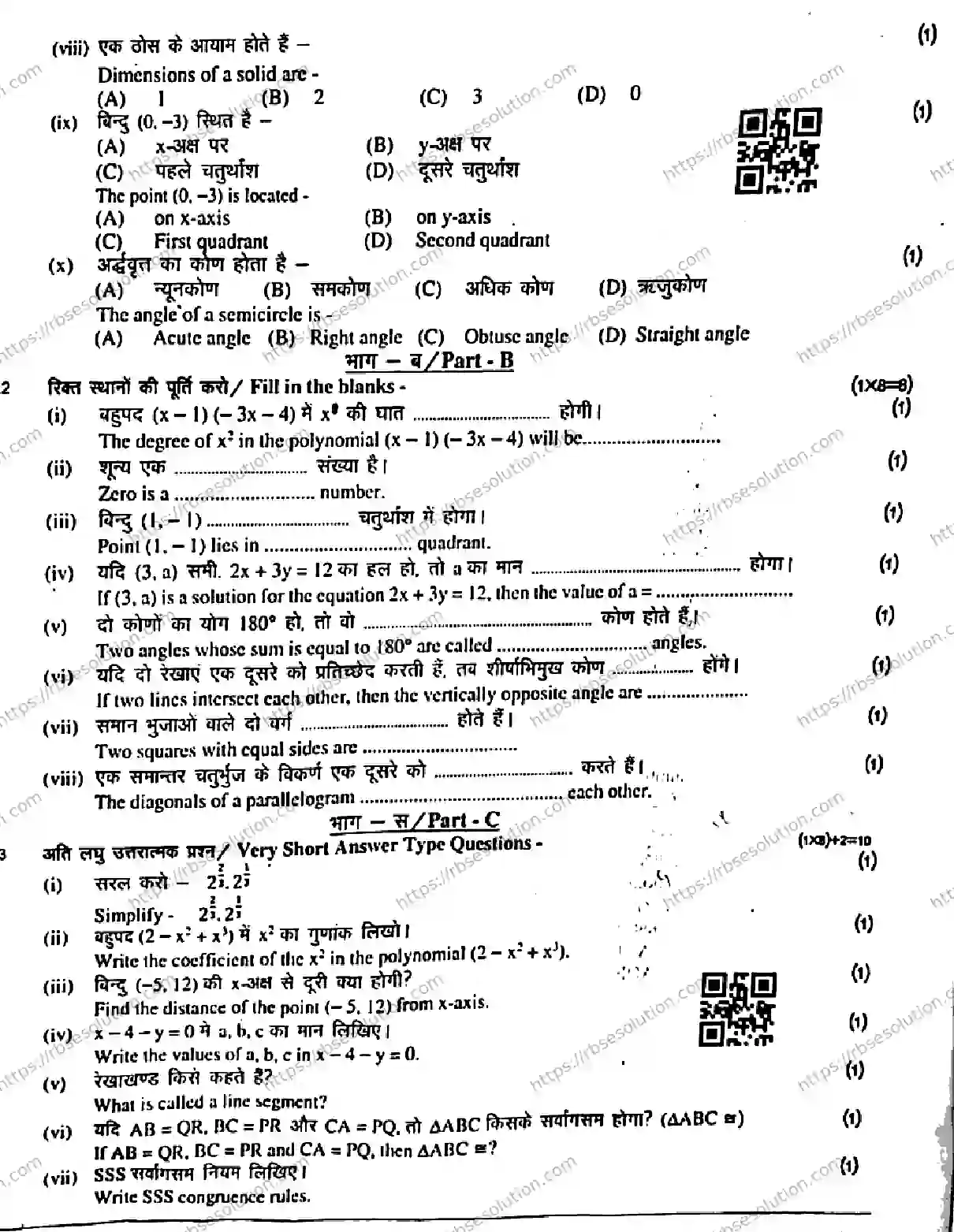
(viii) एक ठोस के आयाम होते हैं -
Dimensions of a solid are -
- (A) 1
- (B) 2
- (C) 3
- (D) 0
Explanation: A solid has three dimensions: length, breadth, and height.
(ix) बिन्दु (0, -3) स्थित है -
The point (0, -3) is located -
- (A) x-अक्ष पर (on x-axis)
- (B) y-अक्ष पर (on y-axis)
- (C) प्रथम चतुर्थांश (First quadrant)
- (D) द्वितीय चतुर्थांश (Second quadrant)
Explanation: The x-coordinate is 0, so the point lies on the y-axis.
(x) अर्धवृत्त का कोण होता है -
The angle of a semicircle is -
- (A) न्यूनकोण (Acute angle)
- (B) समकोण (Right angle)
- (C) अधिक कोण (Obtuse angle)
- (D) ऋजुकोण (Straight angle)
Explanation: The angle in a semicircle is always a right angle (90°).
Part-B (Fill in the Blanks)
(i) बहुपद (x – 1)(x² – 3x – 4) में x² की घात ______ होगी।
The degree of x² in the polynomial (x – 1)(x² – 3x – 4) will be ______.
Answer: 3 (तीन)
Explanation: (x – 1)(x² – 3x – 4) = x³ – 3x² – 4x – x² + 3x + 4 = x³ – 4x² – x + 4. The highest power of x is 3, so the degree is 3.
(ii) शून्य एक ______ संख्या है।
Zero is a ______ number.
Answer: पूर्ण (whole) / वास्तविक (real)
(iii) बिंदु (1, –2) ______ चतुर्थांश में होगा।
Point (1, –2) lies in ______ Quadrant.
Answer: चतुर्थ (Fourth)
Explanation: x positive, y negative → Fourth quadrant.
(iv) यदि (3, a) समीकरण 2x + 3y = 2 का हल हो, तो a का मान = ______
If (3, a) is a solution for the equation 2x + 3y = 2, then the value of a = ______
Answer: –4/3
Explanation: 2(3) + 3a = 2 → 6 + 3a = 2 → 3a = –4 → a = –4/3.
(v) दो कोणों का योग 180° हो, तो वे कोण ______ होते हैं।
Two angles whose sum is equal to 180° are called ______ angles.
Answer: संपूरक (supplementary)
(vi) यदि दो रेखाएं एक दूसरे को प्रतिच्छेद करती हैं, तब शीर्षाभिमुख कोण ______ होंगे।
If two lines intersect each other, then the vertically opposite angles are ______.
Answer: बराबर (equal)
(vii) समान भुजाओं वाले दो वर्ग ______ होते हैं।
Two squares with equal sides are ______.
Answer: सर्वांगसम (congruent)
(viii) एक समांतर चतुर्भुज के विकर्ण एक दूसरे को ______ करते हैं।
The diagonals of a parallelogram ______ each other.
Answer: समद्विभाजित (bisect)
Part-C (Very Short Answer Type Questions)
(i) सरल करो – Simplify: 2⁵ × 2²
Answer: 2⁷ = 128
Explanation: Using law of exponents: aᵐ × aⁿ = aᵐ⁺ⁿ → 2⁵⁺² = 2⁷ = 128.
(ii) बहुपद (2 – x² + x³) में x² का गुणांक लिखो।
Write the coefficient of x² in the polynomial (2 – x² + x³).
Answer: –1
Explanation: The term with x² is –x², so coefficient is –1.
(iii) बिंदु (5, 2) की x-अक्ष से दूरी क्या होगी?
Find the distance of the point (5, 2) from x-axis.
Answer: 2 इकाई (units)
Explanation: Distance from x-axis = absolute value of y-coordinate = |2| = 2.
(iv) x – 4 – y = 0 में a, b, c का मान लिखिए।
Write the values of a, b, c in x – 4 – y = 0.
Answer: a = 1, b = –1, c = –4
Explanation: Standard form: ax + by + c = 0 → x – y – 4 = 0 → a = 1, b = –1, c = –4.
(v) रेखाखंड किसे कहते हैं?
What is called a line segment?
Answer: रेखाखंड एक सीधी रेखा का वह भाग है जो दो निश्चित बिंदुओं के बीच घिरा होता है।
A line segment is the part of a straight line bounded by two fixed points (endpoints).
(vi) यदि AB = QR, BC = PR और CA = PQ, तो ΔABC किसके सर्वांगसम होगा? (ΔABC ≅ ?)
If AB = QR, BC = PR and CA = PQ, then ΔABC ≅ ?
Answer: ΔABC ≅ ΔQRP
Explanation: By SSS congruence: AB = QR, BC = RP, CA = PQ → ΔABC ≅ ΔQRP.
(vii) SSS सर्वांगसम नियम लिखिए।
Write SSS congruence rule.
Answer: यदि एक त्रिभुज की तीनों भुजाएँ दूसरे त्रिभुज की तीनों भुजाओं के बराबर हों, तो दोनों त्रिभुज सर्वांगसम होते हैं।
If three sides of one triangle are equal to three sides of another triangle, then the two triangles are congruent.
प्रश्न 4
(viii) चक्रीय चतुर्भुज को परिभाषित कीजिए।
Define cyclic quadrilateral.
परिभाषा: चक्रीय चतुर्भुज वह चतुर्भुज होता है जिसके सभी चारों शीर्ष एक ही वृत्त पर स्थित होते हैं।
Definition: A cyclic quadrilateral is a quadrilateral whose all four vertices lie on a single circle.
(ix) आकृति में ∠PQR = 100° है, जहाँ P, Q तथा R केन्द्र 'O' वाले एक वृत्त पर स्थित बिन्दु हैं। ∠OPR ज्ञात कीजिए।
In the figure ∠PQR = 100°, where P, Q and R are points on a circle with centre 'O'. Find ∠OPR.
हल:
चूँकि P, Q, R एक वृत्त पर स्थित हैं, इसलिए चाप PR द्वारा केंद्र पर बना कोण ∠POR = 2 × ∠PQR = 2 × 100° = 200° होगा।
त्रिभुज OPR में, OP = OR (एक ही वृत्त की त्रिज्याएँ), अतः ∠OPR = ∠ORP.
त्रिभुज OPR में कोण योग गुण से:
∠OPR + ∠ORP + ∠POR = 180°
⇒ 2∠OPR + 200° = 180°
⇒ 2∠OPR = -20° (यह संभव नहीं है, अतः चाप PR बड़ा चाप है)
वास्तव में, चाप PQR (बड़ा चाप) द्वारा केंद्र पर बना कोण = 360° - 200° = 160°
अब, त्रिभुज OPR में:
∠OPR + ∠ORP + 160° = 180°
⇒ 2∠OPR = 20°
⇒ ∠OPR = 10°
अतः ∠OPR = 10°
भाग — D / Part-D
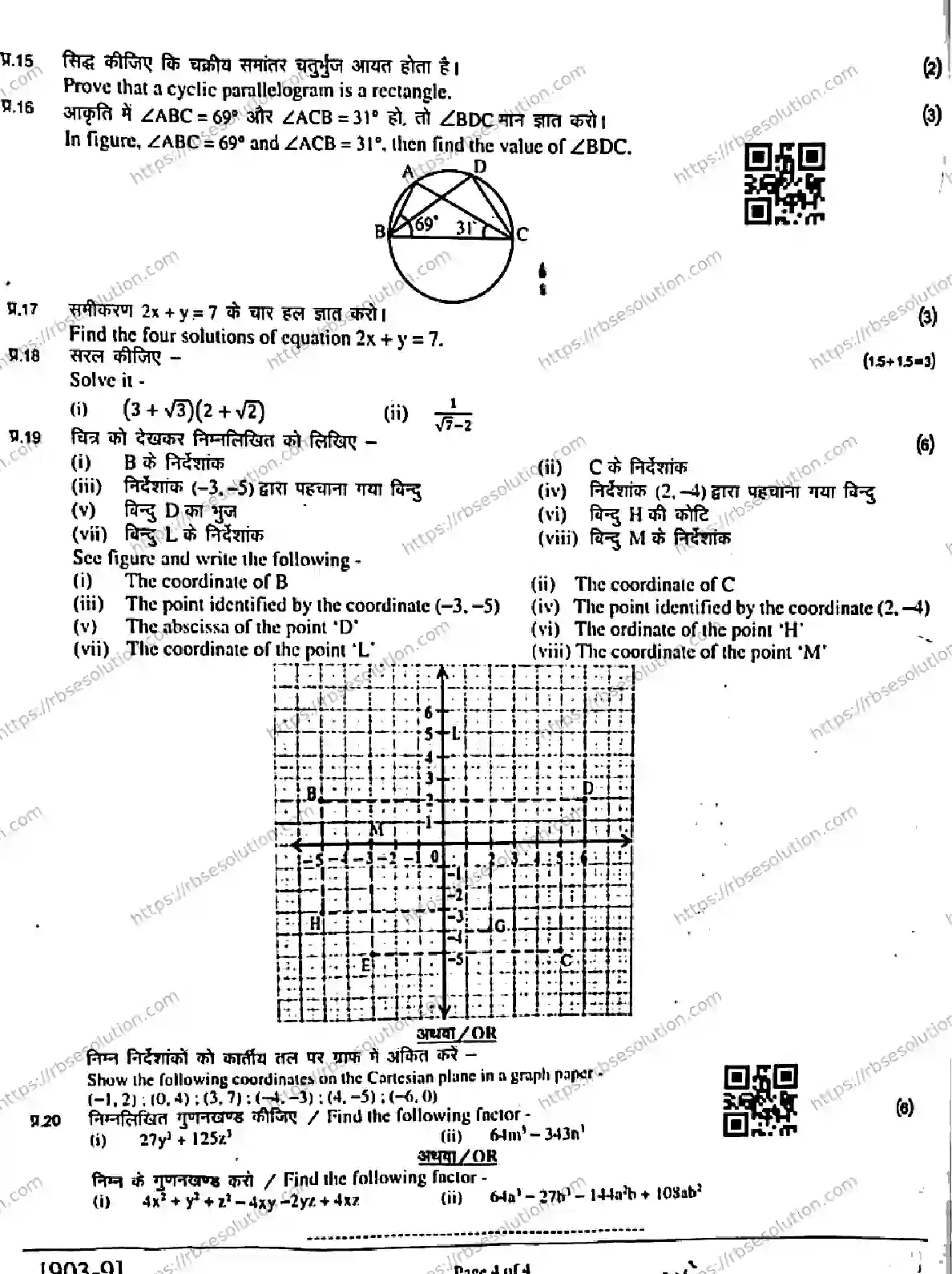
1. सरल कीजिए — (3 + √3)(2 + √2)
Simplify — (3 + √3)(2 + √2)
हल:
(3 + √3)(2 + √2) = 3×2 + 3×√2 + √3×2 + √3×√2
= 6 + 3√2 + 2√3 + √6
उत्तर: 6 + 3√2 + 2√3 + √6
2. सरल कीजिए — (7√3 × 8√7)
Simplify — (7√3 × 8√7)
हल:
7√3 × 8√7 = (7×8) × (√3×√7) = 56 × √21 = 56√21
उत्तर: 56√21
3. निम्नलिखित बिन्दुओं का कार्तीय तल में स्थान निर्धारित कीजिए —
Determine the position of following points in the Cartesian plane.
(5, 0), (0, 5), (2, 5), (5, 2), (-3, 5), (-3, -5), (5, 3), (6, 1)
हल: प्रत्येक बिन्दु का स्थान निम्न प्रकार है:
- (5, 0) — x-अक्ष पर, मूल बिन्दु से 5 इकाई दाएँ
- (0, 5) — y-अक्ष पर, मूल बिन्दु से 5 इकाई ऊपर
- (2, 5) — प्रथम चतुर्थांश में, x=2, y=5
- (5, 2) — प्रथम चतुर्थांश में, x=5, y=2
- (-3, 5) — द्वितीय चतुर्थांश में, x=-3, y=5
- (-3, -5) — तृतीय चतुर्थांश में, x=-3, y=-5
- (5, 3) — प्रथम चतुर्थांश में, x=5, y=3
- (6, 1) — प्रथम चतुर्थांश में, x=6, y=1
4. बिन्दु (-5, -7) के लिए निम्न का उत्तर लिखिए —
Write the following answer for the point (-5, -7):
(i) x-निर्देशांक (ii) y-निर्देशांक (iii) x-अक्ष से दूरी
हल:
- (i) x-निर्देशांक = -5
- (ii) y-निर्देशांक = -7
- (iii) x-अक्ष से दूरी = |y-निर्देशांक| = |-7| = 7 इकाई
5. रैखिक समीकरण x + 2y = 1 के दो हल लिखिए।
Write two solutions of the linear equation x + 2y = 1.
हल:
समीकरण x + 2y = 1 में:
- यदि y = 0, तो x + 2(0) = 1 ⇒ x = 1, अतः हल (1, 0)
- यदि x = 0, तो 0 + 2y = 1 ⇒ y = 1/2, अतः हल (0, 1/2)
दो हल: (1, 0) और (0, 1/2)
6. x² - 9 के गुणनखंड कीजिए।
Factor of x² - 9.
हल:
x² - 9 = x² - 3² = (x - 3)(x + 3)
उत्तर: (x - 3)(x + 3)
7. 3 और 4 के बीच में पाँच परिमेय संख्या ज्ञात कीजिए।
Find five rational numbers between 3 and 4.
हल:
3 और 4 के बीच पाँच परिमेय संख्याएँ ज्ञात करने के लिए, हम 3 और 4 को 6 के हर वाली भिन्नों में लिख सकते हैं:
3 = 18/6, 4 = 24/6
अतः 18/6 और 24/6 के बीच पाँच परिमेय संख्याएँ:
19/6, 20/6, 21/6, 22/6, 23/6
या सरल रूप में: 19/6, 10/3, 7/2, 11/3, 23/6
8. यदि रैखिक समीकरण x - 2 = 0 हो, तो a, b और c का मान ज्ञात करें।
If linear equation x - 2 = 0, then find the value of a, b, and c.
हल:
रैखिक समीकरण का सामान्य रूप ax + by + c = 0 होता है।
दिया गया समीकरण: x - 2 = 0
इसे सामान्य रूप में लिखने पर: 1·x + 0·y + (-2) = 0
अतः a = 1, b = 0, c = -2
9. यूक्लिड के अभिगृहीत लिखिए।
Write the Euclid's axioms.
यूक्लिड के अभिगृहीत (Euclid's Axioms):
- वे वस्तुएँ जो एक ही वस्तु के बराबर हों, एक-दूसरे के बराबर होती हैं।
- यदि बराबरों में बराबर जोड़े जाएँ, तो पूर्ण भी बराबर होते हैं।
- यदि बराबरों में से बराबर घटाए जाएँ, तो शेष भी बराबर होते हैं।
- जो वस्तुएँ एक-दूसरे से मेल खाती हों, वे एक-दूसरे के बराबर होती हैं।
- पूर्ण अपने भाग से बड़ा होता है।
10. दी गई आकृति में केन्द्र 'O' वाले एक वृत्त पर तीन बिन्दु A, B और C इस प्रकार हैं कि ∠BOC = 30° तथा ∠AOB = 60° है। यदि चाप ABC के अतिरिक्त वृत्त पर D एक बिन्दु है, तो ∠ADC ज्ञात कीजिए।
In the given figure, A, B and C are three points on a circle with centre 'O' such that ∠BOC = 30° and ∠AOB = 60°. If D is a point on the circle other than the arc ABC, find ∠ADC.
हल:
∠AOC = ∠AOB + ∠BOC = 60° + 30° = 90°
चाप ABC (बड़ा चाप) द्वारा केंद्र पर बना कोण = 360° - 90° = 270°
बिन्दु D चाप ABC पर स्थित है, अतः ∠ADC चाप ABC द्वारा शेष भाग पर बना कोण है।
चाप ABC द्वारा वृत्त के शेष भाग पर बना कोण = 1/2 × (केंद्र पर बना कोण) = 1/2 × 270° = 135°
अतः ∠ADC = 135°
11. K का मान ज्ञात कीजिए, यदि x = 2, y = 1 समीकरण 2x + 3y = K का एक हल है।
Find the value of K, if x = 2, y = 1 is a solution of the equation 2x + 3y = K.
हल:
समीकरण 2x + 3y = K में x = 2 और y = 1 रखने पर:
2(2) + 3(1) = K
⇒ 4 + 3 = K
⇒ K = 7
अतः K का मान 7 है।